Thursday, 30 June 2022
P.R. CHINA
This cover from China depicts a joint issue China-México issued in 2022, celebrating 2 World Heritage Sites: the Historic Monuments of Dengfeng in the Centre of Heaven and Earth and the Pre-Hispanic City of Cichen-Itza. Dengfeng is a county-level city of Henan Province, South Central China. The city is one of the most renowned spiritual centers of China, and is home to various religious institutions and famous temples such as the Taoist Zhongyue Temple, the Buddhist Shaolin Temple (a renowned center for martial arts), as well as the Confucian Songyang Academy and the Gaocheng Observatory, hence its poetic expression derived from Chinese literature as the spiritual "center of heaven and earth". Parts of the city were inscribed on the UNESCO World Heritage List in 2010. The sacred site of Chichen-Itza was one of the greatest Mayan centres of the Yucatán peninsula. Throughout its nearly 1,000-year history, different peoples have left their mark on the city. The Maya and Toltec vision of the world and the universe is revealed in their stone monuments and artistic works. The fusion of Mayan construction techniques with new elements from central Mexico make Chichen-Itza one of the most important examples of the Mayan-Toltec civilization in Yucatán. Several buildings have survived, such as the Warriors’ Temple, El Castillo and the circular observatory known as El Caracol. The site was inscribed as a UNESCO World Heritage Site in 1988.
P.R. CHINA
This cover from China depicts a joint issue China-México issued in 2022, celebrating 2 World Heritage Sites: the Historic Monuments of Dengfeng in the Centre of Heaven and Earth and the Pre-Hispanic City of Cichen-Itza. Dengfeng is a county-level city of Henan Province, South Central China. The city is one of the most renowned spiritual centers of China, and is home to various religious institutions and famous temples such as the Taoist Zhongyue Temple, the Buddhist Shaolin Temple (a renowned center for martial arts), as well as the Confucian Songyang Academy and the Gaocheng Observatory, hence its poetic expression derived from Chinese literature as the spiritual "center of heaven and earth". Parts of the city were inscribed on the UNESCO World Heritage List in 2010. The sacred site of Chichen-Itza was one of the greatest Mayan centres of the Yucatán peninsula. Throughout its nearly 1,000-year history, different peoples have left their mark on the city. The Maya and Toltec vision of the world and the universe is revealed in their stone monuments and artistic works. The fusion of Mayan construction techniques with new elements from central Mexico make Chichen-Itza one of the most important examples of the Mayan-Toltec civilization in Yucatán. Several buildings have survived, such as the Warriors’ Temple, El Castillo and the circular observatory known as El Caracol. The site was inscribed as a UNESCO World Heritage Site in 1988.
Sunday, 26 June 2022
KAZAKHSTAN
This cover from Kazakhstan depicts 2 stamps issued in 2003 celebrating the UNESCO World Heritage site Petroglyphs within the Archaeological Landscape of Tamgaly. Petroglyphs in the Tanbaly Gorge in Chu-Ili mountains depict humans, animals, and religious figures. They date from the second half of the second millennium BC to the beginning of the 20th century and provide insight into the life of pastoral communities that lived in the region. A number of tombs, kurgans, and enclosures from Bronze and Iron Age have also been found in the area. Tamgaly became a UNESCO World Heritage Site in 2004. Tamgaly is located 170 km (by road) northwest of Almaty.
CROATIA
This cover came from Croatia and depicts 3 different stamps, including the stamp on the right corner celebrating theFort of St. Nikola in Sibenik-Knin County. The monument is part of the site Venetian Works of Defence between the 16th and 17th Centuries: Stato da Terra - Western Stato da Mar, a UNESCO World Heritage Site comprising six bastion forts built by the Republic of Venice on its mainland domains (Stato da Terra) and its Domains of the Sea (Stato da Mar). With the increase in firearm warfare in the Renaissance came significant shifts in military strategy and fort design. One of these changes was the development of the bastion fort, or alla moderna fortifications, with a polygon-shaped fortress with bulwarks at the corners. These designs originated from the Republic of Venice, but would soon spread throughout Europe and remain the standard for defence until the 19th century. In 2017, six of these fortifications in Italy, Croatia, and Montenegro were inscribed on the UNESCO World Heritage list. These six sites provide quintessential examples of this fort design, demonstrate the influence of Renaissance-era Venice, and pay testimony to a major advancement in the history of warfare. The sites that make up the World Heritage site demonstrate the breadth of the architectural styles and fortresses employed by the Venetians. Built in the 15th century, the fortified town of Kotor is the oldest site, displaying a transitional period between traditional fortress design and alla moderna design. In the 16th century, the fortifications in Bergamo and the Fort of St. Nikola were built, showing the addition of a more complex and centralized system of bastions, walls, and moats. The defences at Zadar, Peschiera del Garda, and Palmanova were completed in the 17th century.
UN NEW YORK
This cover from United Nations (New York Office) depicts 2 stamps of same ype, celebrating the Mausoleum of the First Qin Emperor. The Mausoleum of the First Qin Emperor (Qin Shi Huang) is located in Lintong District, Xi'an, Shaanxi province of China. This mausoleum was constructed over 38 years, from 246 to 208 BC, and is situated underneath a 76-meter-tall tomb mound shaped like a truncated pyramid. The layout of the mausoleum is modeled on the Qin capital Xianyang, divided into inner and outer cities. The tomb itself has not yet been excavated. Archaeological explorations currently concentrate on various sites of the extensive necropolis surrounding the tomb, including the Terracotta Army to the east of the tomb mound. The Terracotta Army served as a garrison to the mausoleum and has yet to be completely excavated. In 1987, the mausoleum, including the Terracotta Warriors, was listed as World Heritage Sites.
Tuesday, 21 June 2022
KAZAKHSTAN
This cover from Kazakhstan depicts a miniature sheet issued in 1996 celebrating the Mausoleum of Khoja Ahmad Yasawi. The Mausoleum of Khawaja Ahmed Yasawi is a mausoleum in the city of Turkestan, in southern Kazakhstan. The structure was commissioned in 1389 by Timur, who ruled the area as part of the expansive Timurid Empire, to replace a smaller 12th-century mausoleum of the famous Turkic poet and Sufi mystic, Khoja Ahmed Yasawi (1093–1166). However, construction was halted with the death of Timur in 1405. The religious structure continues to draw pilgrims from across Central Asia and has come to epitomize the Kazakh national identity. It has been protected as a national monument, while UNESCO recognized it as the country's first site of patrimony, declaring it a World Heritage Site in 2003.
Sunday, 19 June 2022
VIETNAM
This cover from Vietnam depicts a miniature sheet issued in 2015, celebrating the Trang An Landscape Complex. Tràng An is a scenic area located at the southern margin of the Red River Delta. It contains limestone karst peaks with valleys. There are archaeological traces of human activity for more than 30,000 years, dating back from the Neolithic and Bronze Ages. Hoa Lư was the ancient capital of Vietnam, established in the 10th and 11th centuries. On 23 June 2014, at the 38th session of the World Heritage Committee in Doha, the Trang An Scenic Landscape Complex was inscribed as a UNESCO World Heritage Site.
GERMANY
This special cover from Germany celebrates the 20th anniversary of the inscription of Stralsund and Wismar as a Wordl Heritage Site. The Historic Centers of Stralsund and Wismar are inscribed as UNESCO world hertitage sites since 2002. The two towns were major Hanseatic League trading centres in the 14th and 15th centuries. They then served as defensive and administrative centres for Sweden two hundred years later, notably during the Thirty Years' War. The architectural styles from both of these periods remain and are well-preserved.
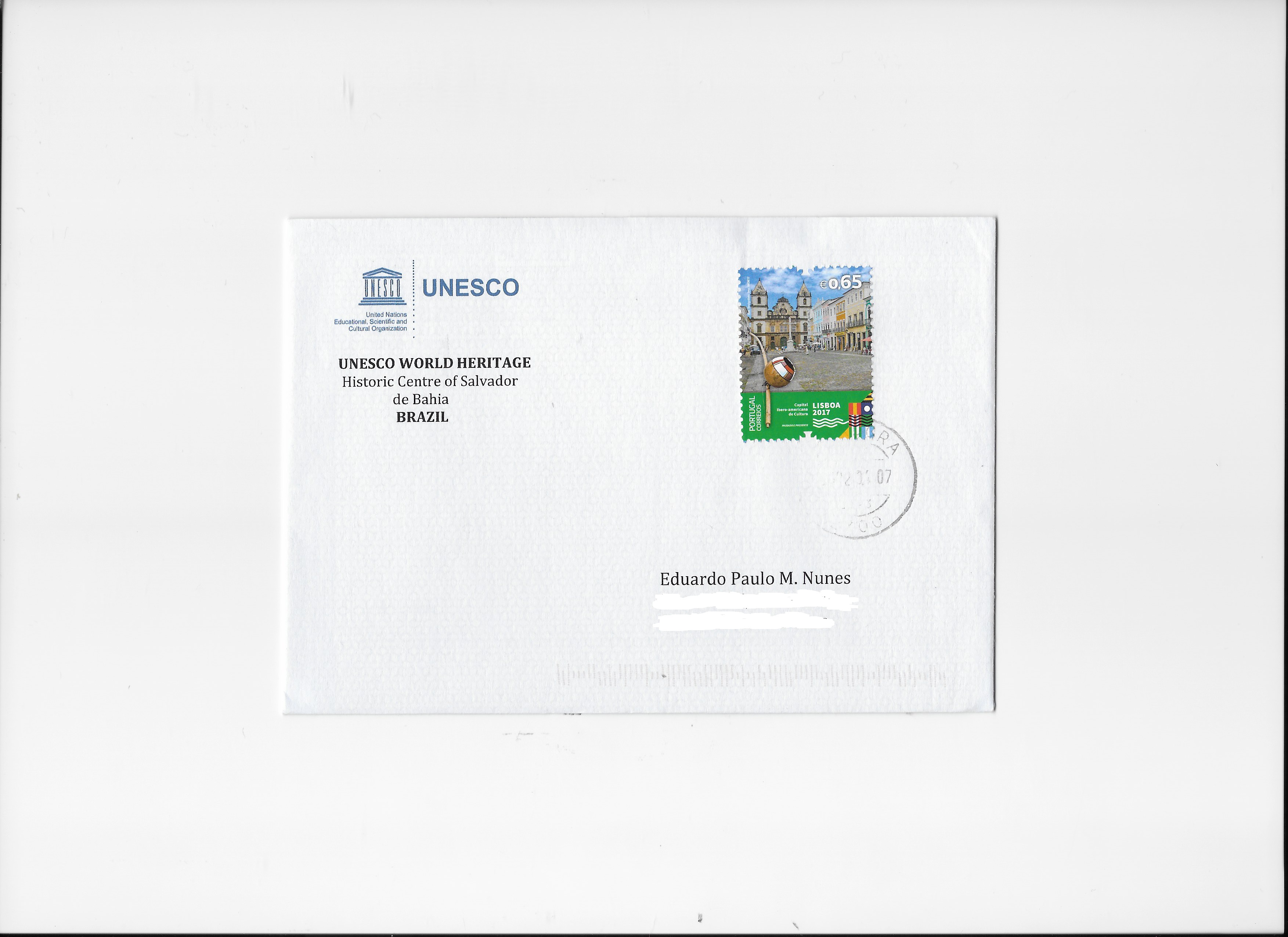
PORTUGAL
This cover from Portugal depicts one single stamp, showing a picture of the town of Salvador de Bahia, Brazil. The Historic Centre of Salvador de Bahia in Brazil, is a historic neighborhood in western Salvador, Bahia. It was the city's center during the Portuguese colonial period and was named for the whipping post in its central plaza where enslaved people from Africa were publicly beaten as punishment for alleged infractions. The Historic Centre is extremely rich in historical monuments dating from the 17th through the 19th centuries. Salvador was the first colonial capital of Brazil and the city is one of the oldest in the New World (founded in 1549 by Portuguese settlers). It was also one of the first slave markets on the continent, with slaves arriving to work on the sugar plantations. The area is in the older part of the upper city (Cidade Alta) of Salvador. It encompasses several blocks around the triangular Largo, and it is the location for music, dining and nightlife. It has a place on the national historic register and was named a world cultural center by UNESCO in 1985.
Subscribe to:
Posts (Atom)