Showing posts with label South Korea. Show all posts
Tuesday, 15 July 2025
Thursday, 21 July 2022
SOUTH KOREA
This cover from South Korea depicts a miniature sheet issued in 1998, celebrating the World Heritage Site Haeinsa Temple Janggyeong Panjeon, the Depositories for the Tripitaka Koreana Woodblocks. Tripitaka Koreana is a collection of over 80 000 wooden printing blocks, engraved in the 13th century. They represent the most complete collection of Buddhist texts, laws, and treaties. The Haeinsa Temple was built in the 15th century with the purpose of storing the woodblocks, with innovative approaches to ensure the conservation. The temple is also an important Buddhist pilgrimage site. The Temple of Haeinsa and the Depositories for the Tripiṭaka Koreana Woodblocks were made a UNESCO World Heritage Site in 1995. The UNESCO committee noted that the buildings housing the Tripiṭaka Koreana are unique because no other historical structure was specifically dedicated to the preservation of artifacts and the techniques used were particularly ingenious.
Monday, 27 August 2018
Thursday, 12 July 2018
SOUTH KOREA
A nice cover from South Korea, depicting a complete set issued in 2016 on topic "Tourist places in Korea".
Sunday, 1 July 2018
SOUTH KOREA
A nice UNESCO cover from South Korea, depicting a complete set issued in 2011 on topic "Donggureung Royal Tomb".
Donggureung Tombs are located in a large forest área, and they are the resting place of Joseon's kings and queens. There are nine royal mausoleums including the tomb of Joseon Dynasty's founder Kinmg Taejo (1335-1408), which is called Geonwolleung. This is the tomb that we can see on both stamps.


Donggureung Tombs are located in a large forest área, and they are the resting place of Joseon's kings and queens. There are nine royal mausoleums including the tomb of Joseon Dynasty's founder Kinmg Taejo (1335-1408), which is called Geonwolleung. This is the tomb that we can see on both stamps.
Tuesday, 19 June 2018
SOUTH KOREA
A nice UNESCO cover from South Korea, depicting a complete set issued in 2012 celebrating the Historic Villages of Korea: Hahoe and Yangdong.
Founded in the 14-15th centuries, Hahoe and Yangdong are the two most representative historic clan villages in the Republic of Korea. The villages were located to provide both physical and spiritual nourishment from their surrounding landscapes
The site is inscribed at UNESCO since 2010.

Founded in the 14-15th centuries, Hahoe and Yangdong are the two most representative historic clan villages in the Republic of Korea. The villages were located to provide both physical and spiritual nourishment from their surrounding landscapes
The site is inscribed at UNESCO since 2010.
SOUTH KOREA
A nice cover from South Korea, depicting a joint issue with Malaysia issued in 2010 on topic "Tigers"
Thursday, 7 June 2018
Tuesday, 5 June 2018
SOUTH KOREA
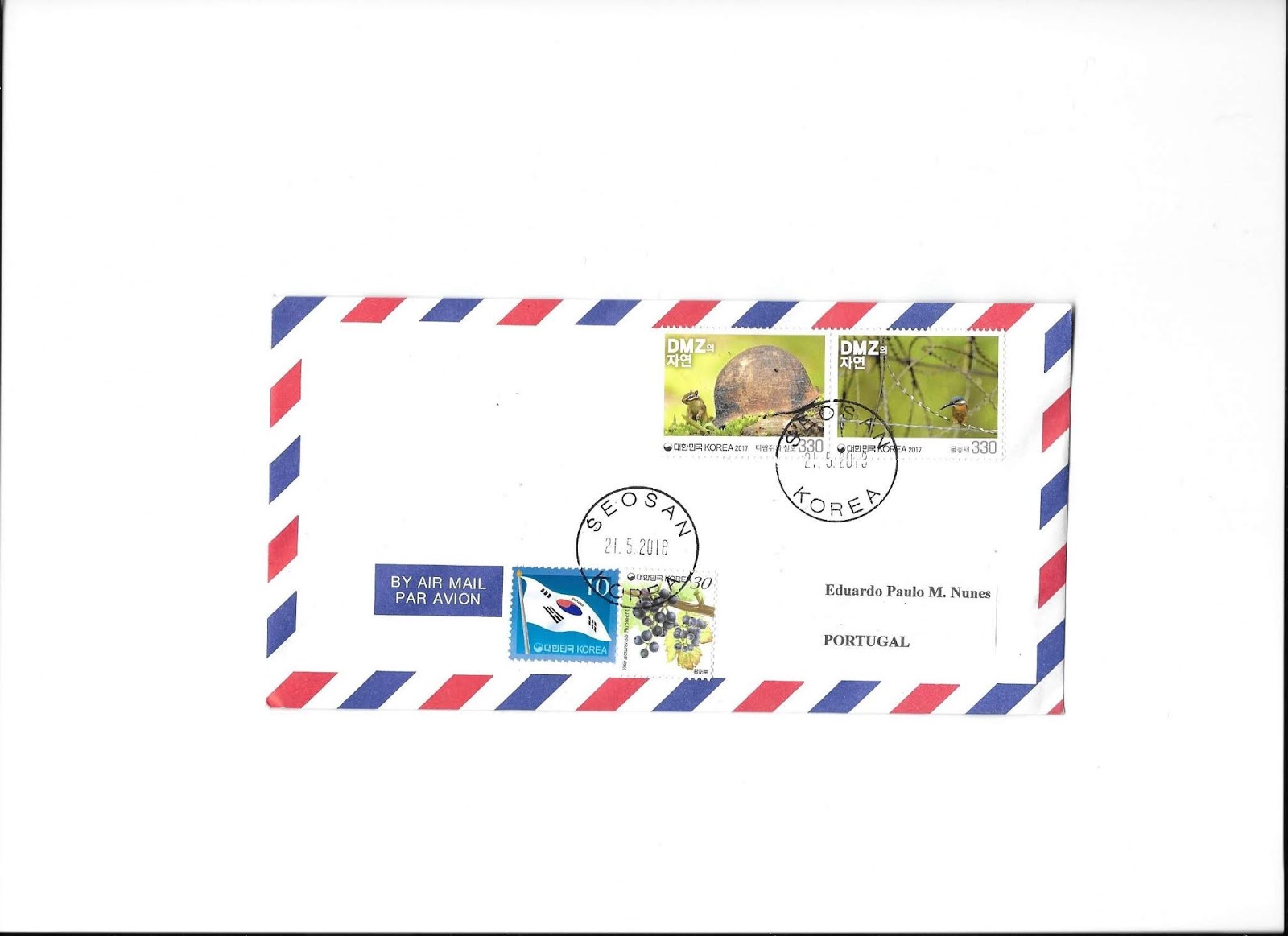
A nice cover from South Korea, depicting a complete set of 2 stamps issued in 2017 on topic "Wild life on the DMZ - demilitarized zone".
Monday, 4 June 2018
SOUTH KOREA
SOUTH KOREA
A nice UNESCO cover from South Korea, depicting a complete set issued in 2017 celebrating "Namsadang Nori".
Inscribed in 2009 on the representative list of the intangible cultural heritage of Humanity, "Namsadang Nori" (literally the all-male vagabond clown theatre), is a multifaceted folk performance tradition, originally practised widely by travelling entertainers. Namsadang Nori carried an importante social message. The mask dance and puppet plays in particular enacted the opression of the lower classes as well as women in a male-dominated society. Through satire, these performances raised issues on behalf of those with no political voice and manifested ideals of equality and freedom, sustaining and inspiring the poor.

Inscribed in 2009 on the representative list of the intangible cultural heritage of Humanity, "Namsadang Nori" (literally the all-male vagabond clown theatre), is a multifaceted folk performance tradition, originally practised widely by travelling entertainers. Namsadang Nori carried an importante social message. The mask dance and puppet plays in particular enacted the opression of the lower classes as well as women in a male-dominated society. Through satire, these performances raised issues on behalf of those with no political voice and manifested ideals of equality and freedom, sustaining and inspiring the poor.
Etiquetas:
South Korea,
South Korea - Namsadang Nori,
Unesco World Heritage
Tuesday, 1 May 2018
SOUTH KOREA
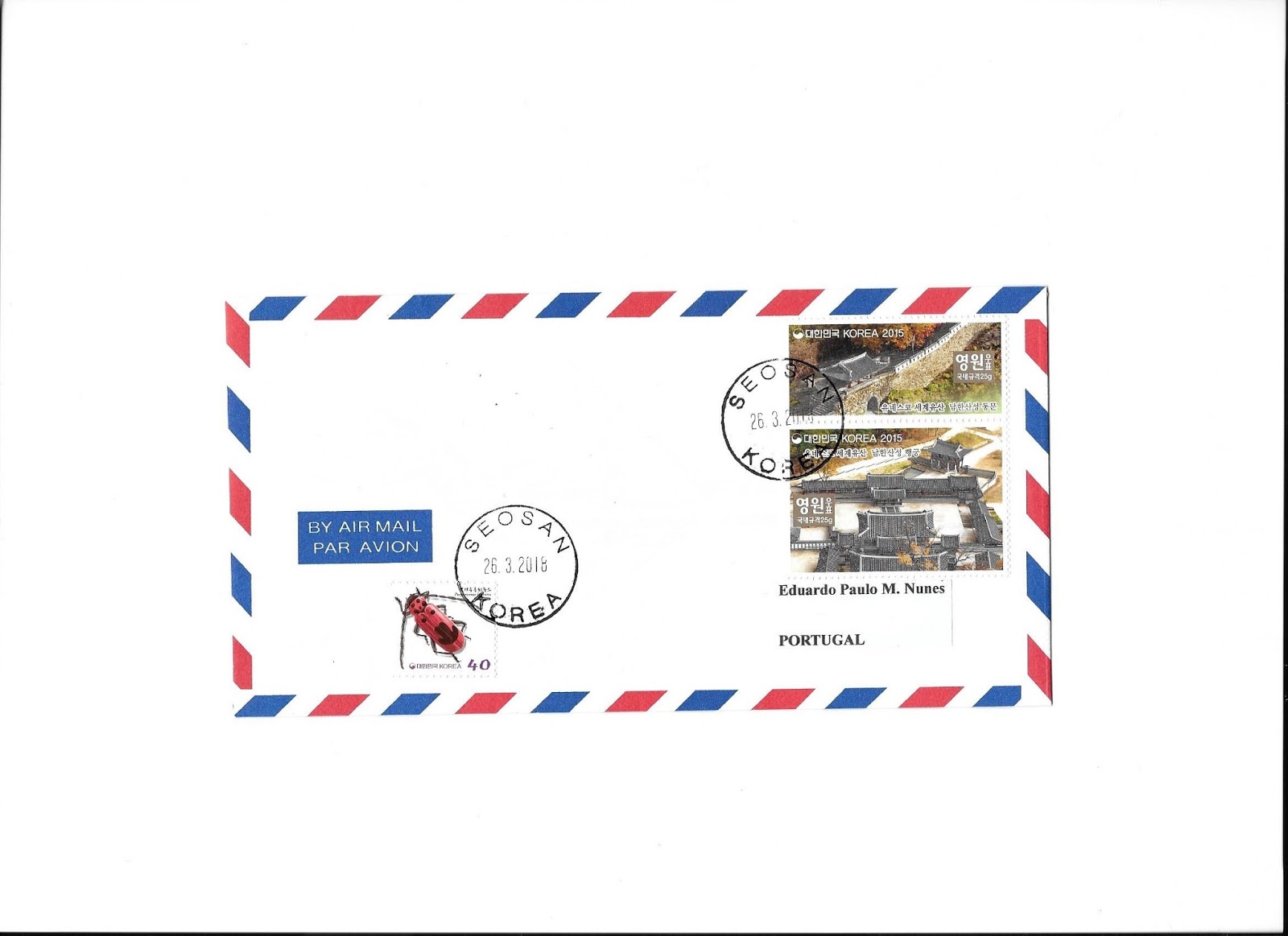
Another nice UNESCO cover from South Korea, depicting a complete set issued in 2015 celebrating the Namhansanseong Fortress, inscribed as an UNESCO site since 2014.
This fortress was designed as an emergency capital for the Joseon dinasty (1392-1910), in a mountainous site 25 km south-east of Seoul. Built and deffended by Buddhist monk-soldiers, it could accomodate 4,000 people and fulfilled importante administrative and militar functions. Its earliest remains date from the 7th century, but it was rebuilt several times, notably in the early 17th century.


This fortress was designed as an emergency capital for the Joseon dinasty (1392-1910), in a mountainous site 25 km south-east of Seoul. Built and deffended by Buddhist monk-soldiers, it could accomodate 4,000 people and fulfilled importante administrative and militar functions. Its earliest remains date from the 7th century, but it was rebuilt several times, notably in the early 17th century.
SOUTH KOREA
A nice cover from South Korea, depicting a joint issue South Korea-Peru (issued in 2013) with 2 beautiful UNESCO sites.
The stamp on the left shows the Seongsan Ilchulbong Peak (Jejudo Island), inscribed as na UNESCO site since 2007.
The stamp on the right shows the well known Sanctuary of Macchu Picchu in Peru.
Machu Picchu, inscribed as Cultural Heritage site since 1983, stands 2,430 m above sea-level, in the middle of a tropical mountain forest, in an extraordinarily beautiful setting. It was probably the most amazing urban creation of the Inca Empire at its height; its giant walls, terraces and ramps seem as if they have been cut naturally in the continuous rock escarpments. The natural setting, on the eastern slopes of the Andes, encompasses the upper Amazon basin with its rich diversity of flora and fauna.


The stamp on the left shows the Seongsan Ilchulbong Peak (Jejudo Island), inscribed as na UNESCO site since 2007.
The stamp on the right shows the well known Sanctuary of Macchu Picchu in Peru.
Machu Picchu, inscribed as Cultural Heritage site since 1983, stands 2,430 m above sea-level, in the middle of a tropical mountain forest, in an extraordinarily beautiful setting. It was probably the most amazing urban creation of the Inca Empire at its height; its giant walls, terraces and ramps seem as if they have been cut naturally in the continuous rock escarpments. The natural setting, on the eastern slopes of the Andes, encompasses the upper Amazon basin with its rich diversity of flora and fauna.
Sunday, 15 April 2018
SOUTH KOREA
Thursday, 12 April 2018
SOUTH KOREA
A nice Fauna cover from South Korea, depicting a complete set issued in 2015 on topic "Endangered species - Wolf".
SOUTH KOREA
A nice Fauna cover from South Korea, depicting a complete set issued in 2016 on topic "Endangered species - Eurasian Otter".
SOUTH KOREA
A nice Fauna cover from South Korea, depicting a complete set issued in 2017 on topic "Endangered species - Korean Mountain Goat".
Tuesday, 8 November 2016
Subscribe to:
Posts (Atom)