Showing posts with label Romania. Show all posts

Wednesday, 19 April 2023

ROMANIA

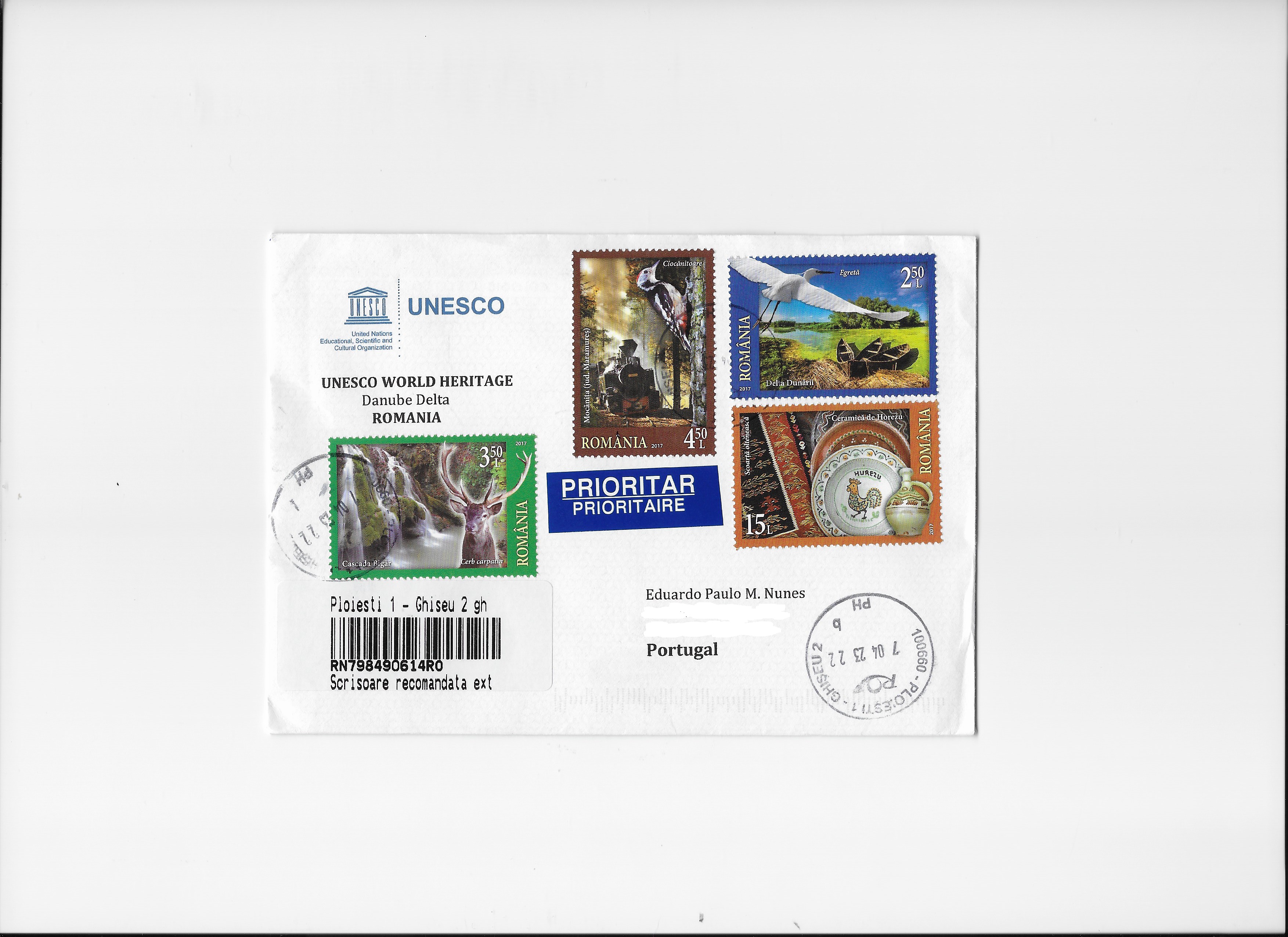
A nice cover from Romania, depicting 4 different "Tourist" stamps, including a 2,50L stamp celebrating the Danube Delta, inscribed as a UNESCO World Heritage site since 1991. The Danube Delta (Romanian: Delta Dunării) is the second largest river delta in Europe, after the Volga Delta, and is the best preserved on the continent. The greater part of the Danube Delta lies in Romania (Tulcea County), with a small part in Ukraine (Odessa Oblast). Its approximate surface area is 4,152 km2, of which 3,446 km2 is in Romania. The Danube Delta, where the Danube river enters the Black Sea, is the largest European wetland. It is home to over 300 bird and 45 freshwater fish species. Important species include sturgeons, European mink, European wildcat, Eurasian otter, and the threatened monk seal.

Monday, 11 July 2022

ROMANIA

This beautiful cover came from Romania and depicts a miniature sheet with a picture of the Domogled Valea Cernei National Park, which is part of the UNESCO site Ancient and Primeval Beech Forests of the Carpathians and Other Regions of Europe. This site comprises undisturbed examples of temperate forests that demonstrate the postglacial expansion process of European beech from a few isolated refuge areas in the Alps, Carpathians, Dinarides, Mediterranean, and Pyrenees. The site was originally listed in 2007 as the Primeval Beech Forests of the Carpathians, shared by Slovakia and Ukraine, extended in 2011 to include the Ancient Beech Forests of Germany, and further extended in 2017 and 2021 to include forests in a total of 18 countries. The Domogled Valea Cernei National Park/> in Romania was listed in 2017.

Friday, 3 June 2022

ROMANIA

This cover from Romania depicts a complete set issued in 2014 celebrating the region of Maramures. The 8,10 leu stamp shows a picture of the Church of the Holy Archangels in Șurdești , which is a part of the UNESCO site Wooden Churches of Maramures This site comprises eight churches from the 17th and 18th century in Maramureș County. The churches are made of wood and they combine influences of Orthodox and Gothic architecture styles. Some of the common characteristics of the churches include tall, slim clock towers and roofs covered by shingles. The list includes the Church of the Presentation of the Virgin in the Temple in Bârsana, the Church of Saint Nicholas in Budești, the Saint Parascheva Church in Desești, the Church of the Nativity of the Virgin in Ieud Deal, the Church of the Holy Archangels in Plopiș, the Saint Parascheva Church in Poienile Izei, the Church of the Holy Archangels in Rogoz and the Church of the Holy Archangels in Șurdești. These eight churches were listed by the UNESCO as World Heritage Sites in 1999, for their religious architecture and timber construction traditions.

Wednesday, 20 April 2022

ROMANIA

A nice UNESCO cover from Romania, depicting a complete set issued in 2009 celebrating the Danube Delta, inscribed as a UNESCO World Heritage site since 1991. The Danube Delta (Romanian: Delta Dunării) is the second largest river delta in Europe, after the Volga Delta, and is the best preserved on the continent. The greater part of the Danube Delta lies in Romania (Tulcea County), with a small part in Ukraine (Odessa Oblast). Its approximate surface area is 4,152 km2, of which 3,446 km2 is in Romania. The Danube Delta, where the Danube river enters the Black Sea, is the largest European wetland. It is home to over 300 bird and 45 freshwater fish species. Important species include sturgeons, European mink, European wildcat, Eurasian otter, and the threatened monk seal.

Wednesday, 12 January 2022

ROMANIA

This cover from Romania depicts 2 stamps of 1L40 celebrating the Danube Delta, inscribed as a UNESCO World Heritage site since 1991. The Danube Delta (Romanian: Delta Dunării) is the second largest river delta in Europe, after the Volga Delta, and is the best preserved on the continent. The greater part of the Danube Delta lies in Romania (Tulcea County), with a small part in Ukraine (Odessa Oblast). Its approximate surface area is 4,152 km2, of which 3,446 km2 is in Romania. The Danube Delta, where the Danube river enters the Black Sea, is the largest European wetland. It is home to over 300 bird and 45 freshwater fish species. Important species include sturgeons, European mink, European wildcat, Eurasian otter, and the threatened monk seal.

Saturday, 4 December 2021

ROMANIA

A nice UNESCO cover from Romania, depicting a miniature sheet issued in 2011 celebrating the Village of Biertan, a part of the UNESCO World Heritage Site Villages with Fortified Churches in Transylvania. This site comprises seven villages with fortified churches that were built between the 13th and the 16th centuries by Transylvanian Saxons. The settlement pattern and the organization of the villages have been preserved since the Middle Ages. Six villages (Câlnic, Dârjiu, Prejmer, Saschiz, Valea Viilor, and Viscri) were listed in the original nomination in 1993 while the village of Biertan was added in 1999.

Monday, 22 November 2021

ROMANIA

A beautiful UNESCO cover from Romania, depicting a miniature sheet issued in 2009 celebrating the Historic Town of Sighișoara. The Historic Centre of Sighișoara (Sighișoara Citadel) is the old historic center of the town of Sighișoara (German: Schäßburg, Hungarian: Segesvár), Romania, built in the 12th century by Saxon settlers. It is an inhabited medieval citadel that, in 1999, was designated a UNESCO World Heritage Site for its 850-year-old testament to the history and culture of the Transylvanian Saxons. Birthplace of Vlad III the Impaler (in Romanian Vlad Țepeș), the city marks the upper boundary of the Land of Sachsen. Like its bigger brothers, Sibiu (Hermannstadt) and Braşov (Kronstadt), Sighișoara exhibits Medieval German architectural and cultural heritage that was preserved even during the Communist period.

Thursday, 11 November 2021

ROMANIA

A nice UNESCO cover from Romania, depicting a miniature sheet issued in 2009 celebrating the Danube Delta, inscribed as a UNESCO World Heritage site since 1991. The Danube Delta (Romanian: Delta Dunării) is the second largest river delta in Europe, after the Volga Delta, and is the best preserved on the continent. The greater part of the Danube Delta lies in Romania (Tulcea County), with a small part in Ukraine (Odessa Oblast). Its approximate surface area is 4,152 km2, of which 3,446 km2 is in Romania. The Danube Delta, where the Danube river enters the Black Sea, is the largest European wetland. It is home to over 300 bird and 45 freshwater fish species. Important species include sturgeons, European mink, European wildcat, Eurasian otter, and the threatened monk seal.

Wednesday, 10 November 2021

ROMANIA

An amazing UNESCO cover from Romania, depicting a miniature sheet issued in 2009 celebrating the Historic Centre of Sighisoara. The historic centre of the city of Sighișoara dates from the 12th century. It was founded by the Transylvanian Saxons, a community of German merchants and craftsmen. They have since lived in the region for over 850 years, though the community is decreasing in numbers due to emigration in modern times. Sighișoara is a well-preserved example of a small fortified medieval town shaped by the interactions of cultures from Central Europe and the Byzantine-Orthodox Southeastern Europe. The site is inscribed at UNESCO world heritage list since 1999.

Wednesday, 27 October 2021

ROMANIA

A nice UNESCO cover from Romania, depicting a miniature sheet issued in 2021 celebrating 30 years of Danube Delta as an UNESCO World Heritage Site. The Danube Delta (Romanian: Delta Dunării) is the second largest river delta in Europe, after the Volga Delta, and is the best preserved on the continent. The greater part of the Danube Delta lies in Romania (Tulcea County), with a small part in Ukraine (Odessa Oblast). Its approximate surface area is 4,152 km2, of which 3,446 km2 is in Romania. The Danube Delta, where the Danube river enters the Black Sea, is the largest European wetland. It is home to over 300 bird and 45 freshwater fish species. Important species include sturgeons, European mink, European wildcat, Eurasian otter, and the threatened monk seal.

ROMANIA

A nice UNESCO cover from Romania, depicting a complete set issued in 2021 celebrating 30 years of Danube Delta as an UNESCO World Heritage Site. The Danube Delta (Romanian: Delta Dunării) is the second largest river delta in Europe, after the Volga Delta, and is the best preserved on the continent. The greater part of the Danube Delta lies in Romania (Tulcea County), with a small part in Ukraine (Odessa Oblast). Its approximate surface area is 4,152 km2, of which 3,446 km2 is in Romania. The Danube Delta, where the Danube river enters the Black Sea, is the largest European wetland. It is home to over 300 bird and 45 freshwater fish species. Important species include sturgeons, European mink, European wildcat, Eurasian otter, and the threatened monk seal.

Wednesday, 13 October 2021

ROMANIA

This cover from Romania depicts a single stamp issued in 2013, celebrating the 350th anniversary of the Church of the Holy Archangels in Rogoz, which is a part of the UNESCO site Wooden Churches of Maramures This site comprises eight churches from the 17th and 18th century in Maramureș County. The churches are made of wood and they combine influences of Orthodox and Gothic architecture styles. Some of the common characteristics of the churches include tall, slim clock towers and roofs covered by shingles. The list includes the Church of the Presentation of the Virgin in the Temple in Bârsana, the Church of Saint Nicholas in Budești, the Saint Parascheva Church in Desești, the Church of the Nativity of the Virgin in Ieud Deal, the Church of the Holy Archangels in Plopiș, the Saint Parascheva Church in Poienile Izei, the Church of the Holy Archangels in Rogoz, and the Church of the Holy Archangels in Șurdești. These eight churches were listed by the UNESCO as World Heritage Sites in 1999, for their religious architecture and timber construction traditions.

Tuesday, 21 September 2021

ROMANIA

A nice UNESCO cover from Romania, depicting a complete set issued in 2009 celebrating the Historic Centre of Sighisoara. The historic centre of the city of Sighișoara dates from the 12th century. It was founded by the Transylvanian Saxons, a community of German merchants and craftsmen. They have since lived in the region for over 850 years, though the community is decreasing in numbers due to emigration in modern times. Sighișoara is a well-preserved example of a small fortified medieval town shaped by the interactions of cultures from Central Europe and the Byzantine-Orthodox Southeastern Europe. The site is inscribed at UNESCO world heritage list since 1999.

Tuesday, 6 April 2021

ROMANIA

A nice cover from Romania, featuring 2 stamps with 2 UNESCO natural sites: Retezat National Park and the Danube Delta. Retezat National Park is inscribed as an UNESCO Biosphere Reserve since 1979. This biosphere reserve is situated in the southern Carpathian Mountains and has an altitude range from low mountain ranges to alpine landscape. Peak Peleaga with 2,509 meters above sea level is the highest elevation in the biosphere reserve. The Retezat Massif is a well-defined upland block, separated on most sides from the rest of the range by deep valleys and to the north overlooking the Tertiary Hateg basin. The area was glaciated in the quaternary and has many landforms caused by glacial erosion. This biosphere reserve is significant for the conservation of European mountain forest diversity. The vegetation is very diverse due to the varied relief and the junction of three floristic regions in this area. The Danube Delta is also a Biosphere Reserve (since 1998) and it's the Europe’s largest wetland and reed bed, and functions as its most important water purification system. The delta has wet soils temporarily covered with water, with plants adapted to living in wet conditions. The Danube Delta also includes fixed and mobile sand dune areas home to psamophilic plants. Grassland ecosystems are located on higher parts of riverine bars and on the edges of reef beds, adjacent to coastal bars. The water ecosystems of the reserve are very diverse, including the freshwater ecosystems of watercourses, limans and numerous lakes and bays, and brackish water ecosystems in the delta of the Kiliya Arm.

Thursday, 12 November 2020

ROMANIA

A nice cover from Romania featuring a miniature sheet issued in 2019 on motive "Protected Fauna of Romania".

Tuesday, 8 September 2020

ROMANIA

A nice cover from Romania, featuring a joint issue with Gibraltar issued in 2020.
 

Saturday, 7 December 2019

ROMANIA

A beautiful FAUNA cover from Romania, depicting a complete set issued in 2019 on topic "Romanian Dog Breeds".

Monday, 11 November 2019

ROMANIA

A beautiful FAUNA cover from Romania, depicting a complete set issued in 2019 on topic "Wild animals and their cubs".

Tuesday, 29 October 2019

ROMANIA

A nice Fauna cover from Romania, depicting a complete set issued in 2019 on topic "EUROPA - National Birds".