Showing posts with label Russia-Historic Centre of Saint Petersburg and Related Groups of Monuments. Show all posts

Thursday, 28 November 2024

RUSSIAN FEDERATION

A cover from Russia depicting a miniature sheet issued in 2022, celebrating 150 years of the AS Popov Central Museum of Telecommunications in St. Petersburg.

Thursday, 12 September 2024

RUSSIAN FEDERATION

A beautiful cover from Russia, depicting a miniature sheet issued in 2024 with a picture of "Peterhof Palace". The Peterhof Palace, meaning "Pieter's Court") is a series of palaces and gardens located in Petergof, Saint Petersburg, Russia, commissioned by Peter the Great as a direct response to the Palace of Versailles by Louis XIV of France. Originally intending it in 1709 for country habitation, Peter the Great sought to expand the property as a result of his visit to the French royal court in 1717, inspiring the nickname of "The Russian Versailles". The architect between 1714 and 1728 was Domenico Trezzini, and the style he employed became the foundation for the Petrine Baroque style favored throughout Saint Petersburg. Also in 1714, Jean-Baptiste Alexandre Le Blond, likely chosen due to his previous collaborations with Versailles landscaper André Le Nôtre, designed the gardens. Francesco Bartolomeo Rastrelli completed an expansion from 1747 to 1756 for Elizabeth of Russia. The palace-ensemble along with the city center is recognized as a UNESCO World Heritage Site. All the city center of St Petersburg is recognized as a UNESCO World Heritage Site.

Sunday, 30 June 2024

RUSSIAN FEDERATION

A cover from Russia, depicting the EUROPA 2017 stamp (on the right corner) on topic "Castles". This stamp depicts the St. Michael's Castle (Mikhailovski Castle), a former royal residence in the historic centre of Saint Petersburg. It was built as a residence for Emperor Paul I by architects Vincenzo Brenna and Vasili Bazhenov in 1797-1801. This monument is part of the UNESCO site "Historic Centre of Saint Petersburg and Related Groups of Minuments". The 'Venice of the North', with its numerous canals and more than 400 bridges, is the result of a vast urban project begun in 1703 under Peter the Great. Later known as Leningrad (in the former USSR), the city is closely associated with the October Revolution. Its architectural heritage reconciles the very different Baroque and pure neoclassical styles, as can be seen in the Admiralty, the Winter Palace, the Marble Palace and the Hermitage. All this group of monuments were recognized by UNESCO as an World Heritage Site in 1990.

Sunday, 4 June 2023

ARMENIA

This cover came from Armenia and depicts a joint issue with Russia issued in 2022. The blue stamp on the left shows a picture of Armyanskaya Apostolskaya Ekateriny armenian apostolic church, in St. Petersburg, Russian Federation. Called The 'Venice of the North', St. Petersburg, with its numerous canals and more than 400 bridges, is the result of a vast urban project begun in 1703 under Peter the Great. Later known as Leningrad (in the former USSR), the city is closely associated with the October Revolution. Its architectural heritage reconciles the very different Baroque and pure neoclassical styles, as can be seen in the Admiralty, the Winter Palace, the Marble Palace and the Hermitage. Historic Centre of Saint Petersburg and Related Groups of Monuments is the name used by UNESCO when it collectively designated the historic core of the Russian city of St. Petersburg, as well as buildings and ensembles located in the immediate vicinity as a World Heritage Site in 1991. The site was recognised for its architectural heritage, fusing Baroque, Neoclassical, and traditional Russian-Byzantine influences.

Sunday, 18 September 2022

RUSSIA

This cover from Russia depicts 2 minisheets, including the one on the left celebrating the 325th Birth Anniversary of Empress Catherine I (1684-1727).

Wednesday, 20 April 2022

UN NEW YORK

This cover from United Nations (Office of New York) depicts 4 stamps (2 of each type) with pictures of two remarquable UNESCO sites in Russian Federation: the Historic Centre of Saint Petersburg and Related Groups of Monuments and the Kremlin and Red Square, in Moscow. Called The 'Venice of the North', St. Petersburg, with its numerous canals and more than 400 bridges, is the result of a vast urban project begun in 1703 under Peter the Great. Later known as Leningrad (in the former USSR), the city is closely associated with the October Revolution. Its architectural heritage reconciles the very different Baroque and pure neoclassical styles, as can be seen in the Admiralty, the Winter Palace, the Marble Palace and the Hermitage. Historic Centre of Saint Petersburg and Related Groups of Monuments is the name used by UNESCO when it collectively designated the historic core of the Russian city of St. Petersburg, as well as buildings and ensembles located in the immediate vicinity as a World Heritage Site in 1991. The site was recognised for its architectural heritage, fusing Baroque, Neoclassical, and traditional Russian-Byzantine influences. The ensemble of the Moscow Kremlin and Red Square is a masterpiece of human creative genius and the main symbol of the country. It took more than 500 years to form, reflecting the history of Russian architecture as well as relationship with the European cultural traditions. Architectural monuments of the Moscow Kremlin and Red Square are the finest examples of national architectural school. Moscow Kremlin was the residence of Great Princes and later the Tzar’s residence. Currently it is the seat of the President of the Russian Federation. The Moscow Kremlin is situated high on the left bank of the Moscow River on the Borovitsky hill. Kremlin walls have the shape of an irregular triangle and surround an area of 27 hectares. The southern wall facing the Moscow River, north-western - the Alexander Garden, the eastern - the Red Square. In 1990 the architectural complex of the Moscow Kremlin and Red Square were included to the World Heritage List of UNESCO.

Saturday, 4 December 2021

RUSSIA

This beautiful cover from Russia depicts a miniature sheet issued celebrating the State Hermitage Museum in St. Petersburg. Called The 'Venice of the North', St. Petersburg, with its numerous canals and more than 400 bridges, is the result of a vast urban project begun in 1703 under Peter the Great. Later known as Leningrad (in the former USSR), the city is closely associated with the October Revolution. Its architectural heritage reconciles the very different Baroque and pure neoclassical styles, as can be seen in the Admiralty, the Winter Palace, the Marble Palace and the Hermitage. Historic Centre of Saint Petersburg and Related Groups of Monuments is the name used by UNESCO when it collectively designated the historic core of the Russian city of St. Petersburg, as well as buildings and ensembles located in the immediate vicinity as a World Heritage Site in 1991. The site was recognised for its architectural heritage, fusing Baroque, Neoclassical, and traditional Russian-Byzantine influences.

Monday, 22 November 2021

RUSSIA

This beautiful cover from Russia depicts a miniature sheet issued in 2010 celebrating the Grand Palace, Tsarskoye Selo, in St. Petersburg. The Tsarskoye Selo palace and park ensemble (the Tsarskoye Selo State Museum-Preserve) is a superb monument of world-ranking architecture and garden-and-park design dating from the eighteenth to early twentieth centuries. Called The 'Venice of the North', St. Petersburg, with its numerous canals and more than 400 bridges, is the result of a vast urban project begun in 1703 under Peter the Great. Later known as Leningrad (in the former USSR), the city is closely associated with the October Revolution. Its architectural heritage reconciles the very different Baroque and pure neoclassical styles, as can be seen in the Admiralty, the Winter Palace, the Marble Palace and the Hermitage. Historic Centre of Saint Petersburg and Related Groups of Monuments is the name used by UNESCO when it collectively designated the historic core of the Russian city of St. Petersburg, as well as buildings and ensembles located in the immediate vicinity as a World Heritage Site in 1991. The site was recognised for its architectural heritage, fusing Baroque, Neoclassical, and traditional Russian-Byzantine influences.

Monday, 1 November 2021

RUSSIA

This beautiful cover from Russia depicts a miniature sheet issued in 2006 celebrating the 250th anniversary of the Grand Palace, Tsarskoye Selo, in St. Petersburg.. The Tsarskoye Selo palace and park ensemble (the Tsarskoye Selo State Museum-Preserve) is a superb monument of world-ranking architecture and garden-and-park design dating from the eighteenth to early twentieth centuries. Called The 'Venice of the North', St. Petersburg, with its numerous canals and more than 400 bridges, is the result of a vast urban project begun in 1703 under Peter the Great. Later known as Leningrad (in the former USSR), the city is closely associated with the October Revolution. Its architectural heritage reconciles the very different Baroque and pure neoclassical styles, as can be seen in the Admiralty, the Winter Palace, the Marble Palace and the Hermitage. Historic Centre of Saint Petersburg and Related Groups of Monuments is the name used by UNESCO when it collectively designated the historic core of the Russian city of St. Petersburg, as well as buildings and ensembles located in the immediate vicinity as a World Heritage Site in 1991. The site was recognised for its architectural heritage, fusing Baroque, Neoclassical, and traditional Russian-Byzantine influences.

Saturday, 30 October 2021

RUSSIA

This cover from Russia depict a miniature sheet issued in 2014 celebrating the 300th anniversary of St. Petersburg Head Post Office, located at the historic centre of St. Petersburg. Called The 'Venice of the North', with its numerous canals and more than 400 bridges, is the result of a vast urban project begun in 1703 under Peter the Great. Later known as Leningrad (in the former USSR), the city is closely associated with the October Revolution. Its architectural heritage reconciles the very different Baroque and pure neoclassical styles, as can be seen in the Admiralty, the Winter Palace, the Marble Palace and the Hermitage. Historic Centre of Saint Petersburg and Related Groups of Monuments is the name used by UNESCO when it collectively designated the historic core of the Russian city of St. Petersburg, as well as buildings and ensembles located in the immediate vicinity as a World Heritage Site in 1991. The site was recognised for its architectural heritage, fusing Baroque, Neoclassical, and traditional Russian-Byzantine influences.

Monday, 25 October 2021

RUSSIA

A nice cover from Russia with a 5.00 stamp celebrating the 300th. anniversary of St. Petersburg and a minisheet celebrating 300 years of the postal service in this city. Called The 'Venice of the North', with its numerous canals and more than 400 bridges, is the result of a vast urban project begun in 1703 under Peter the Great. Later known as Leningrad (in the former USSR), the city is closely associated with the October Revolution. Its architectural heritage reconciles the very different Baroque and pure neoclassical styles, as can be seen in the Admiralty, the Winter Palace, the Marble Palace and the Hermitage. Historic Centre of Saint Petersburg and Related Groups of Monuments is the name used by UNESCO when it collectively designated the historic core of the Russian city of St. Petersburg, as well as buildings and ensembles located in the immediate vicinity as a World Heritage Site in 1991. The site was recognised for its architectural heritage, fusing Baroque, Neoclassical, and traditional Russian-Byzantine influences.

Wednesday, 13 October 2021

RUSSIA

A cover from Russia with 2 stamps (on the left) celebrating St. Petersburg and 1 miniature sheet celebrating the 150th Anniversary of Hermitage Museum, also in St Petersburg. Called The 'Venice of the North', with its numerous canals and more than 400 bridges, is the result of a vast urban project begun in 1703 under Peter the Great. Later known as Leningrad (in the former USSR), the city is closely associated with the October Revolution. Its architectural heritage reconciles the very different Baroque and pure neoclassical styles, as can be seen in the Admiralty, the Winter Palace, the Marble Palace and the Hermitage. Historic Centre of Saint Petersburg and Related Groups of Monuments is the name used by UNESCO when it collectively designated the historic core of the Russian city of St. Petersburg, as well as buildings and ensembles located in the immediate vicinity as a World Heritage Site in 1991. The site was recognised for its architectural heritage, fusing Baroque, Neoclassical, and traditional Russian-Byzantine influences.

Sunday, 10 October 2021

RUSSIA

A cover from Russia with 2 stamps and 1 minisheet (all on the left), celebrating St. Petersburg. Called The 'Venice of the North', with its numerous canals and more than 400 bridges, is the result of a vast urban project begun in 1703 under Peter the Great. Later known as Leningrad (in the former USSR), the city is closely associated with the October Revolution. Its architectural heritage reconciles the very different Baroque and pure neoclassical styles, as can be seen in the Admiralty, the Winter Palace, the Marble Palace and the Hermitage. Historic Centre of Saint Petersburg and Related Groups of Monuments is the name used by UNESCO when it collectively designated the historic core of the Russian city of St. Petersburg, as well as buildings and ensembles located in the immediate vicinity as a World Heritage Site in 1991. The site was recognised for its architectural heritage, fusing Baroque, Neoclassical, and traditional Russian-Byzantine influences.

Tuesday, 5 October 2021

RUSSIA

A beautiful cover from Russia with a lot of stamps. The minisheet on the left celebrates the 250th anniversary of the Russian Academy of Arts in St Petersburg.The Russian Academy of Arts, informally known as the Saint Petersburg Academy of Arts, was founded in 1757 by the founder of the Imperial Moscow University Ivan Shuvalov under the name Academy of the Three Noblest Arts. This building is located at the Historical Centre of Saint Petersburg. The Historic Centre of Saint Petersburg and Related Groups of Monuments is the name used by UNESCO when it collectively designated the historic core of the Russian city of St. Petersburg, as well as buildings and ensembles located in the immediate vicinity as a World Heritage Site in 1991.

Saturday, 21 August 2021

RUSSIA

A cover from Russia, depicting 3 stamps issued in 2013 celebrating the Historical Centre of St. Petersburg. This area is part of the UNESCO site "Historic Centre of Saint Petersburg and Related Groups of Minuments". The 'Venice of the North', with its numerous canals and more than 400 bridges, is the result of a vast urban project begun in 1703 under Peter the Great. Later known as Leningrad (in the former USSR), the city is closely associated with the October Revolution. Its architectural heritage reconciles the very different Baroque and pure neoclassical styles, as can be seen in the Admiralty, the Winter Palace, the Marble Palace and the Hermitage. All this group of monuments were recognized by UNESCO as an World Heritage Site in 1990.

Tuesday, 27 July 2021

MONTENEGRO

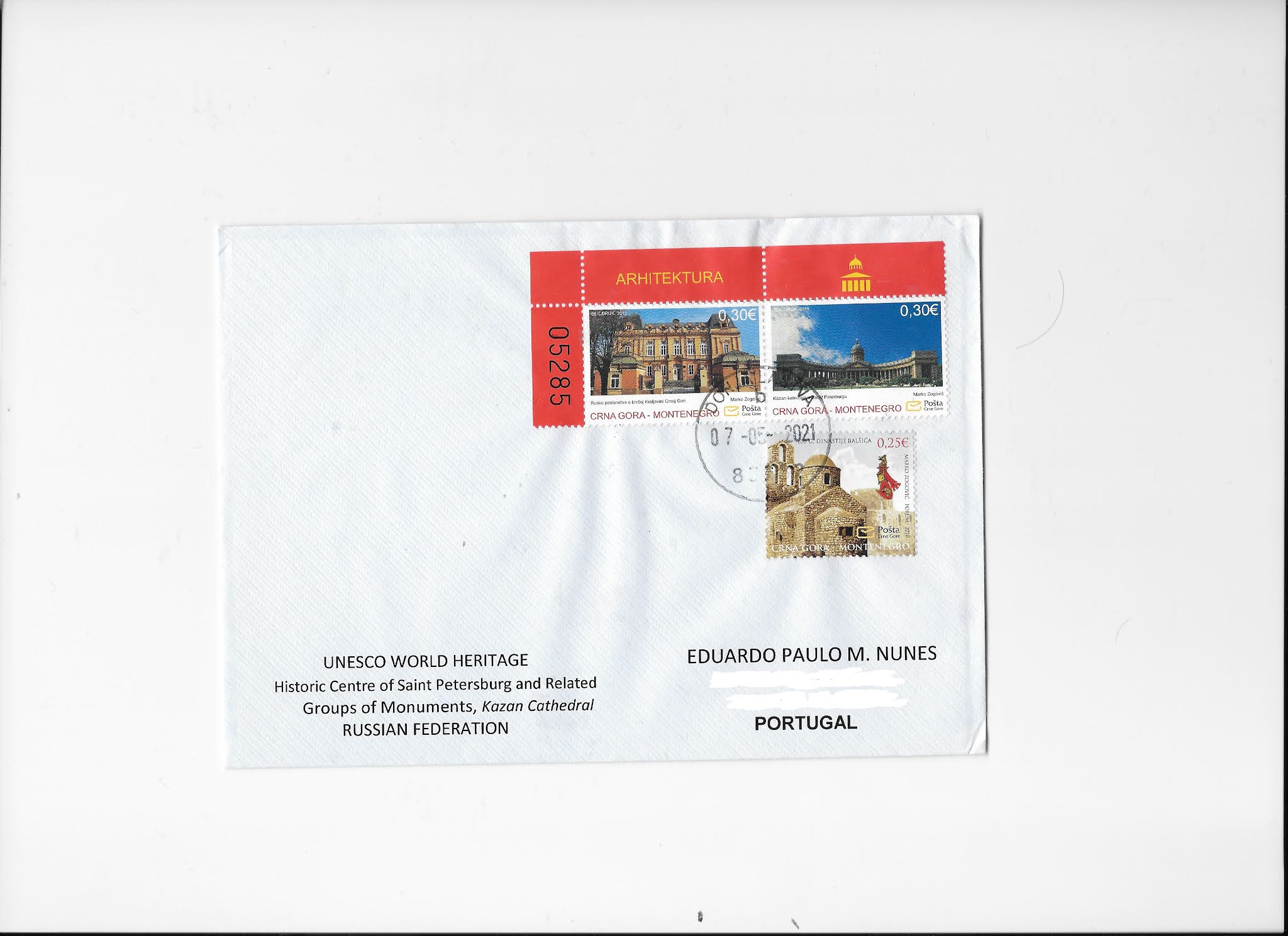
This cover from Montenegro depicts 3 different stamps with historic buildings, including the stamp on the right top corner celebrating the Kazan Cathedral in St. Petersburg, Russia. Kazan Cathedral, also known as the Cathedral of Our Lady of Kazan, is a cathedral of the Russian Orthodox Church on the Nevsky Prospekt in Saint Petersburg. It is dedicated to Our Lady of Kazan, one of the most venerated icons in Russia. Construction of the cathedral started in 1801 and continued for ten years under the supervision of Alexander Sergeyevich Stroganov. This building is part of the UNESCO site "Historic Centre of Saint Petersburg and Related Groups of Monuments" , the name used by UNESCO when it collectively designated the historic core of the Russian city of St. Petersburg, as well as buildings and ensembles located in the immediate vicinity as a World Heritage Site in 1991. The site was recognised for its architectural heritage, fusing Baroque, Neoclassical, and traditional Russian-Byzantine influences.

Thursday, 11 January 2018

RUSSIA

A cover from Russia, depicting the EUROPA 2017 stamp on topic "Castles". This stamps depicts the St. Michael's Castle (Mikhailovski Castle), a former royal residence in the historic centre of Saint Petersburg. It was built as a residence for Emperor Paul I by architects Vincenzo Brenna and Vasili Bazhenov in 1797-1801. This monument is part of the UNESCO site "Historic Centre of Saint Petersburg and Related Groups of Minuments". The 'Venice of the North', with its numerous canals and more than 400 bridges, is the result of a vast urban project begun in 1703 under Peter the Great. Later known as Leningrad (in the former USSR), the city is closely associated with the October Revolution. Its architectural heritage reconciles the very different Baroque and pure neoclassical styles, as can be seen in the Admiralty, the Winter Palace, the Marble Palace and the Hermitage. All this group of monuments were recognized by UNESCO as an World Heritage Site in 1990. Resultado de imagem para Mikhailovsky Castle

Thursday, 31 August 2017

RUSSIA

A cover from Russia, depicting the EUROPA 2017 stamp on topic "Castles". This stamps depicts the St. Michael's Castle (Mikhailovski Castle), a former royal residence in the historic centre of Saint Petersburg. It was built as a residence for Emperor Paul I by architects Vincenzo Brenna and Vasili Bazhenov in 1797-1801. This monument is part of the UNESCO site "Historic Centre of Saint Petersburg and Related Groups of Minuments". The 'Venice of the North', with its numerous canals and more than 400 bridges, is the result of a vast urban project begun in 1703 under Peter the Great. Later known as Leningrad (in the former USSR), the city is closely associated with the October Revolution. Its architectural heritage reconciles the very different Baroque and pure neoclassical styles, as can be seen in the Admiralty, the Winter Palace, the Marble Palace and the Hermitage. All this group of monuments were recognized by UNESCO as an World Heritage Site in 1990.