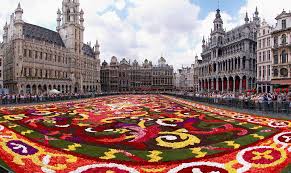
"La Grand-Place" in Brussels, which is represented in the 3,00 zt stamp, is inscribed at UNESCO as a World Heritage place. This big square is a remarkably body of public and private buildings, dating mainly from the late 17th century. The architecture provides a vivid illustration of the level of social and cultural life of the period in this importante political and comercial centre.
Showing posts with label Belgium - La Grand Place in Brussels. Show all posts
Tuesday, 10 October 2017
POLAND
A nice cover from Poland, depicting 3 nice stamps on topic "Capital cities of the European Union". The three capitals are Nicosia (Cyprus), Bratislava (Slovakia) and Brussels (Belgium).
"La Grand-Place" in Brussels, which is represented in the 3,00 zt stamp, is inscribed at UNESCO as a World Heritage place. This big square is a remarkably body of public and private buildings, dating mainly from the late 17th century. The architecture provides a vivid illustration of the level of social and cultural life of the period in this importante political and comercial centre.


"La Grand-Place" in Brussels, which is represented in the 3,00 zt stamp, is inscribed at UNESCO as a World Heritage place. This big square is a remarkably body of public and private buildings, dating mainly from the late 17th century. The architecture provides a vivid illustration of the level of social and cultural life of the period in this importante political and comercial centre.
Tuesday, 13 June 2017
BELGIUM
A nice UNESCO cover from Belgium, depicting a complete set issued in 2000 with 3 Unesco places in thheir own country:La Grand-Place (Great Square) in Brussels, the Flemish Béguinages and The Four Lifts on the Canal do Centre.
La Grand-Place in Brussels (since 1998) is a remarkably body of public and private buildings, dating mainly from the late 17th. century. The architecture provides a vivid ilustration of the level of social and cultural life of the period in this important political and commercial centre.

The Béguines were women who dedicated their lives to God without retiring from the world. In the 13th century they founded the béguinages,enclosed communities designed to meet their spiritual and material needs. The Flemish béguinages (inscribed at Unesco sites since 1998) are architectural ensembles composed of houses, churches, ancillary buildings and green spaces, with a layout of either urban or rural origin and built in styles specific to the Flemish region. They are a fascinating reminder of the tradition of the Béguines that developed in north-western Europe in the Middle Ages.


The Four hydraulic boat-lifts (inscribed as Unesco places since 1998) of the historic Canal du Centre are industrial monuments of the highest quality. Together with the canal itself and its associated structures, they constitute a remarkably well-preserved and complete exemple of a late 19th. century industrial landscape. Of the eight hydraulic boat-lifts built at the end of the 19thb century and beggining of the 20th century, the only ones in the world still existing in their original working condition are these four lifts on the Canal du Centre.


La Grand-Place in Brussels (since 1998) is a remarkably body of public and private buildings, dating mainly from the late 17th. century. The architecture provides a vivid ilustration of the level of social and cultural life of the period in this important political and commercial centre.
The Béguines were women who dedicated their lives to God without retiring from the world. In the 13th century they founded the béguinages,enclosed communities designed to meet their spiritual and material needs. The Flemish béguinages (inscribed at Unesco sites since 1998) are architectural ensembles composed of houses, churches, ancillary buildings and green spaces, with a layout of either urban or rural origin and built in styles specific to the Flemish region. They are a fascinating reminder of the tradition of the Béguines that developed in north-western Europe in the Middle Ages.
The Four hydraulic boat-lifts (inscribed as Unesco places since 1998) of the historic Canal du Centre are industrial monuments of the highest quality. Together with the canal itself and its associated structures, they constitute a remarkably well-preserved and complete exemple of a late 19th. century industrial landscape. Of the eight hydraulic boat-lifts built at the end of the 19thb century and beggining of the 20th century, the only ones in the world still existing in their original working condition are these four lifts on the Canal du Centre.
Subscribe to:
Posts (Atom)

