Friday, 30 July 2021

RUSSIA

THis UNESCO cover from Russia depicts a complte set of 3 stamps issued in 2004 dedicated to the "Golden Mountaisn of Altai". Golden Mountains of Altai is the name of an UNESCO World Heritage Site consisting of the Altai and Katun Natural Reserves, Lake Teletskoye, Belukha Mountain, and the Ukok Plateau. As stated in the UNESCO description of the site, "the region represents the most complete sequence of altitudinal vegetation zones in central Siberia, from steppe, forest-steppe, mixed forest, subalpine vegetation to alpine vegetation". While making its decision, UNESCO also cited Russian Altai's importance for preservation of the globally endangered mammals, such as snow leopard and the Altai argali. The site covers a vast area of 16,175 km². It is inscribed as an UNESCO World Heritage Site since 1998.

Wednesday, 28 July 2021

PORTUGAL

This UNESCO cover from Portugal depicts a single stamp issued in 2012, celebrating the "Alto Douro Wine Region", inscribed as an UNESCO World Heritage Site since 2001. The beautifully unique landscape of the Douro was one of the reasons that made it a World Heritage site in 2001. One of the criteria on which UNESCO based this decision was the importance of the human hand in the shaping of the landscape, using traditional methods and transforming it from a sterile land. The cultural landscape of the Alto Douro is an outstanding example of a traditional European wine-producing region, reflecting the evolution of this human activity over time.” Another criterion was that the “cultural landscape of the Alto Douro is an outstanding example of a traditional European wine producing region, reflecting the evolution of this human activity over time. Unesco also highlights the traces of the remaining or extinct civilizations, many of which were wine producers, such as the Romans that left behind remains of their stone tanks (Lagares). The Douro landscape reflects its ancient and deep connection with the wine culture, creating an amazing picture of Man and Nature working side by side in search of the perfect wine.

Tuesday, 27 July 2021

MONTENEGRO

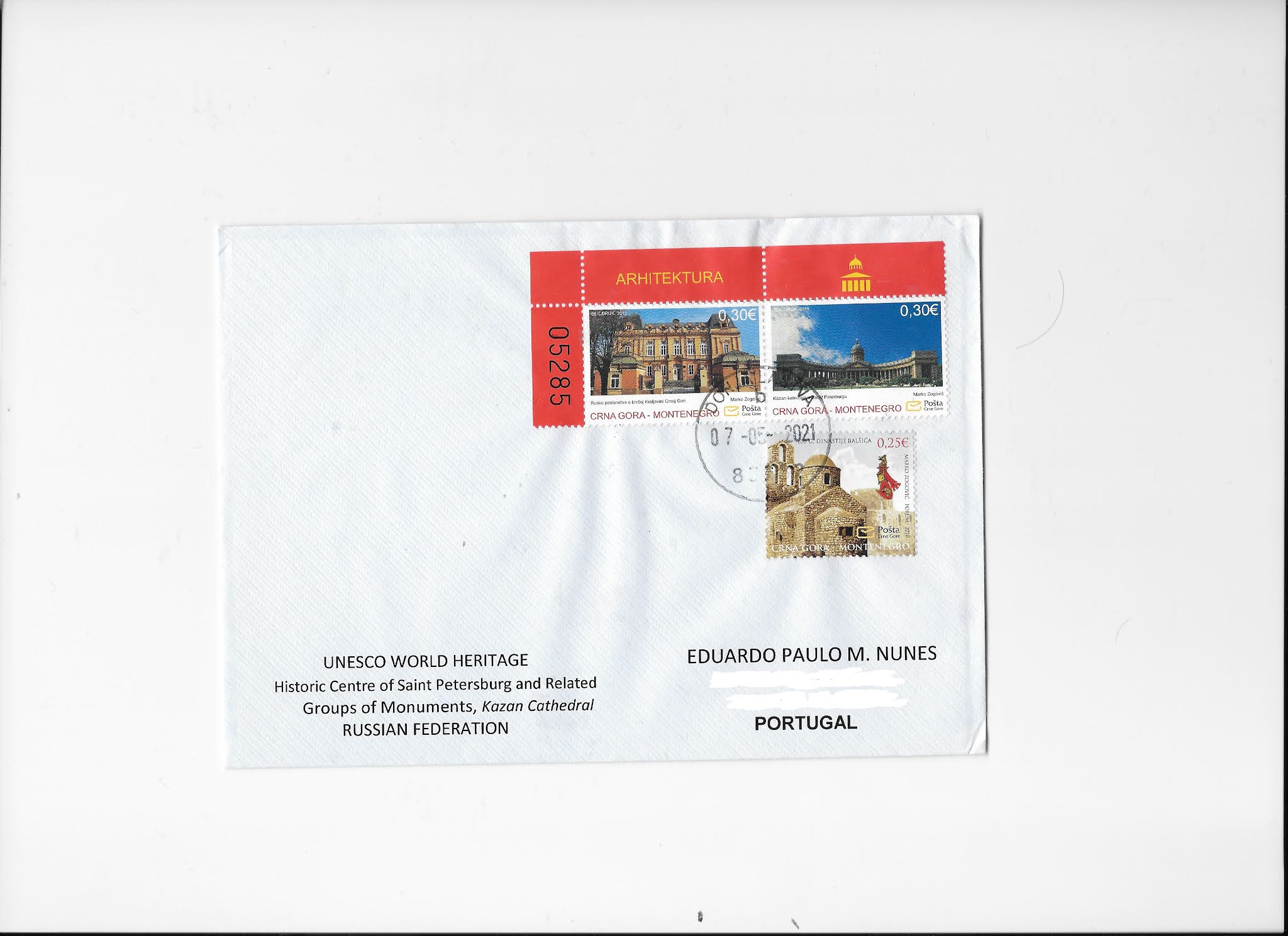
This cover from Montenegro depicts 3 different stamps with historic buildings, including the stamp on the right top corner celebrating the Kazan Cathedral in St. Petersburg, Russia. Kazan Cathedral, also known as the Cathedral of Our Lady of Kazan, is a cathedral of the Russian Orthodox Church on the Nevsky Prospekt in Saint Petersburg. It is dedicated to Our Lady of Kazan, one of the most venerated icons in Russia. Construction of the cathedral started in 1801 and continued for ten years under the supervision of Alexander Sergeyevich Stroganov. This building is part of the UNESCO site "Historic Centre of Saint Petersburg and Related Groups of Monuments" , the name used by UNESCO when it collectively designated the historic core of the Russian city of St. Petersburg, as well as buildings and ensembles located in the immediate vicinity as a World Heritage Site in 1991. The site was recognised for its architectural heritage, fusing Baroque, Neoclassical, and traditional Russian-Byzantine influences.

Monday, 26 July 2021

RUSSIA

A UNESCO cover from Russia, depicting on the left corner a complete set of 3 stamps celebrating the "Virgin Komi Forests". The Virgin Komi Forests is a natural UNESCO World Heritage site in the Northern Ural Mountains of the Komi Republic, Russia. At 32,800 km² it is the largest virgin forest in Europe. The Virgin Komi Forests belong to the Ural Mountains taiga ecoregion. Dominant tree species include Siberian Spruce, Siberian Fir and Siberian Larch, while the most prominent mammals are the reindeer, the sable, the mink and the hare. Its World Heritage Site status was recognised in 1995, making it the first natural World Heritage site in the country.

MOROCCO

Friday, 23 July 2021

RUSSIA

An amazing UNESCO cover from Russia, featuring a miniature sheet issued in 2015 celebrating the Old City of Derbent. The Citadel, Ancient City and Fortress Buildings of Derbent were part of the northern lines of the Sasanian Persian Empire, which extended east and west of the Caspian Sea. The fortification was built in stone. It consisted of two parallel walls that formed a barrier from the seashore up to the mountain. The town of Derbent was built between these two walls, and has retained part of its medieval fabric. The site continued to be of great strategic importance until the 19th century. Derbent is located in Dagestan, on the Caspian Sea. It is the southernmost city in Russia, and it is the second-most important city of Dagestan. Derbent occupies the narrow gateway between the Caspian Sea and the Caucasus Mountains connecting the Eurasian Steppe to the north and the Iranian Plateau to the south. It has a population of roughly 120 thousand residents. Derbent claims to be the oldest city in Russia with historical documentation dating to the 8th century BCE, making it one of the oldest continuously inhabited cities in the world. Due to its strategic location, over the course of history, the city changed ownership many times, particularly among the Persian, Arab, Mongol, Timurid, Shirvan and Iranian kingdoms. In the 19th century, the city passed from Iranian into Russian hands by the Treaty of Gulistan of 1813. It was declared a Wordl Heritage site by UNESCO in 2003.

Tuesday, 20 July 2021

CZECH REPUBLIC

A nice UNESCO cover from Czech Republic, depicting a miniature sheet issued in 2014 celebrating the Cathedral of St. Vitus Cathedral in Prague. Prague, situated on the banks of the Vltava river, has been an important European city since the Middle Ages. Prague is home to a number of well-known cultural attractions, many of which survived the violence and destruction of 20th-century Europe. Main attractions include Prague Castle, Charles Bridge, Old Town Square with the Prague astronomical clock, the Jewish Quarter, St. Vitus Cathedral and Vyšehrad. Since 1992, the extensive historic centre of Prague has been included in the UNESCO list of World Heritage Sites.

MONACO

A cover from Monaco, featuring the EUROPA CEPT issued in 2021 on motive "Endangered Species".

MONTENEGRO

Friday, 16 July 2021

GREECE

A cover from Greece with 3 different stamps, including the stamp on the right corner celebrating Mount Athos. Mount Athos is a mountain and peninsula in northeastern Greece and an important centre of Eastern Orthodox monasticism. It is governed as an autonomous polity within the Hellenic Republic. Mount Athos is home to 20 monasteries under the direct jurisdiction of the Ecumenical Patriarch of Constantinople. Mount Athos has been inhabited since ancient times and is known for its long Christian presence and historical monastic traditions, which date back to at least AD 800 and the Byzantine era. Today, over 2,000 monks from Greece and many other countries, including Eastern Orthodox countries such as Romania, Moldova, Georgia, Bulgaria, Serbia and Russia, live an ascetic life in Athos, isolated from the rest of the world. The Athonite monasteries feature a rich collection of well-preserved artifacts, rare books, ancient documents, and artworks of immense historical value, and Mount Athos has been listed as a World Heritage site since 1988. Although Mount Athos is legally part of the European Union like the rest of Greece, the Monastic State of the Holy Mountain and the Athonite institutions have a special jurisdiction which was reaffirmed during the admission of Greece to the European Community. This empowers the Monastic State's authorities to regulate the free movement of people and goods in its territory; in particular, only males are allowed to enter.

Wednesday, 14 July 2021

P. R. CHINA

A beautiful UNESCO cover from P.R. China, depicting a complet set issued in 2021 celebrating the "Fujian Tulou". The Fujian tulou (Fujian earthen buildings) are Chinese rural dwellings unique to the Hakka in the mountainous areas in southeastern Fujian, China. They were mostly built between the 12th and the 20th centuries. A tulou is usually a large, enclosed and fortified earth building, most commonly rectangular or circular in configuration, with very thick load-bearing rammed earth walls between three and five stories high and housing up to 800 people. Smaller interior buildings are often enclosed by these huge peripheral walls which can contain halls, storehouses, wells and living areas, the whole structure resembling a small fortified city. The fortified outer structures are formed by compacting earth, mixed with stone, bamboo, wood and other readily available materials, to form walls up to 1.80 m thick. Branches, strips of wood and bamboo chips are often laid in the wall as additional reinforcement. The result is a well-lit, well-ventilated, windproof and earthquake-proof building that is warm in winter and cool in summer. Tulous usually have only one main gate. The top level of these earth buildings has gun holes for defensive purposes. A total of 46 Fujian tulou sites were inscribed in 2008 by UNESCO as World Heritage Site, as "exceptional examples of a building tradition and function exemplifying a particular type of communal living and defensive organization [in a] harmonious relationship with their environment". The inscribed sites include Chuxi tulou group, Tianluokeng tulou cluster, Hekeng tulou cluster, Gaobei tulou cluster, Dadi tulou cluster, Hongkeng tulou cluster, Yangxian Lou, Huiyuan Lou, Zhengfu Lou and Hegui Lou.

LUXEMBOURG

A nice cover from Luxembourg with 2 stamps: the stamp on the top features the "Bock Casemates" in the city of Luxembourg and the other stamp celebrates the Luxembourg City Museum. Belonging to the UNESCO World Heritage, the first underground tunnels were built in 1644, in the era of the Spanish domination. The 23-kilometre long galleries were enlarged only 40 years later by Vauban, the French military engineer and fortress builder, and in the eighteenth century by the Austrians. The subterranean defensive passages were placed on different levels and reached down as far as 40 metres. After the dismantling of the fortress in 1867, 17 kilometres of the casemates were spared, left in good condition. Since 1933 the Bock and Pétrusse casemates have been open to the public. The fortress ramparts and the historically impressive Old Town enjoy international reputation: in 1994 UNESCO listed Luxembourg's old town and fortifications including the casemates as World Heritage.