Sunday, 26 June 2022
UN NEW YORK
This cover from United Nations (New York Office) depicts 2 stamps of same ype, celebrating the Mausoleum of the First Qin Emperor. The Mausoleum of the First Qin Emperor (Qin Shi Huang) is located in Lintong District, Xi'an, Shaanxi province of China. This mausoleum was constructed over 38 years, from 246 to 208 BC, and is situated underneath a 76-meter-tall tomb mound shaped like a truncated pyramid. The layout of the mausoleum is modeled on the Qin capital Xianyang, divided into inner and outer cities. The tomb itself has not yet been excavated. Archaeological explorations currently concentrate on various sites of the extensive necropolis surrounding the tomb, including the Terracotta Army to the east of the tomb mound. The Terracotta Army served as a garrison to the mausoleum and has yet to be completely excavated. In 1987, the mausoleum, including the Terracotta Warriors, was listed as World Heritage Sites.
Tuesday, 21 June 2022
KAZAKHSTAN
This cover from Kazakhstan depicts a miniature sheet issued in 1996 celebrating the Mausoleum of Khoja Ahmad Yasawi. The Mausoleum of Khawaja Ahmed Yasawi is a mausoleum in the city of Turkestan, in southern Kazakhstan. The structure was commissioned in 1389 by Timur, who ruled the area as part of the expansive Timurid Empire, to replace a smaller 12th-century mausoleum of the famous Turkic poet and Sufi mystic, Khoja Ahmed Yasawi (1093–1166). However, construction was halted with the death of Timur in 1405. The religious structure continues to draw pilgrims from across Central Asia and has come to epitomize the Kazakh national identity. It has been protected as a national monument, while UNESCO recognized it as the country's first site of patrimony, declaring it a World Heritage Site in 2003.
Sunday, 19 June 2022
VIETNAM
This cover from Vietnam depicts a miniature sheet issued in 2015, celebrating the Trang An Landscape Complex. Tràng An is a scenic area located at the southern margin of the Red River Delta. It contains limestone karst peaks with valleys. There are archaeological traces of human activity for more than 30,000 years, dating back from the Neolithic and Bronze Ages. Hoa Lư was the ancient capital of Vietnam, established in the 10th and 11th centuries. On 23 June 2014, at the 38th session of the World Heritage Committee in Doha, the Trang An Scenic Landscape Complex was inscribed as a UNESCO World Heritage Site.
GERMANY
This special cover from Germany celebrates the 20th anniversary of the inscription of Stralsund and Wismar as a Wordl Heritage Site. The Historic Centers of Stralsund and Wismar are inscribed as UNESCO world hertitage sites since 2002. The two towns were major Hanseatic League trading centres in the 14th and 15th centuries. They then served as defensive and administrative centres for Sweden two hundred years later, notably during the Thirty Years' War. The architectural styles from both of these periods remain and are well-preserved.
PORTUGAL
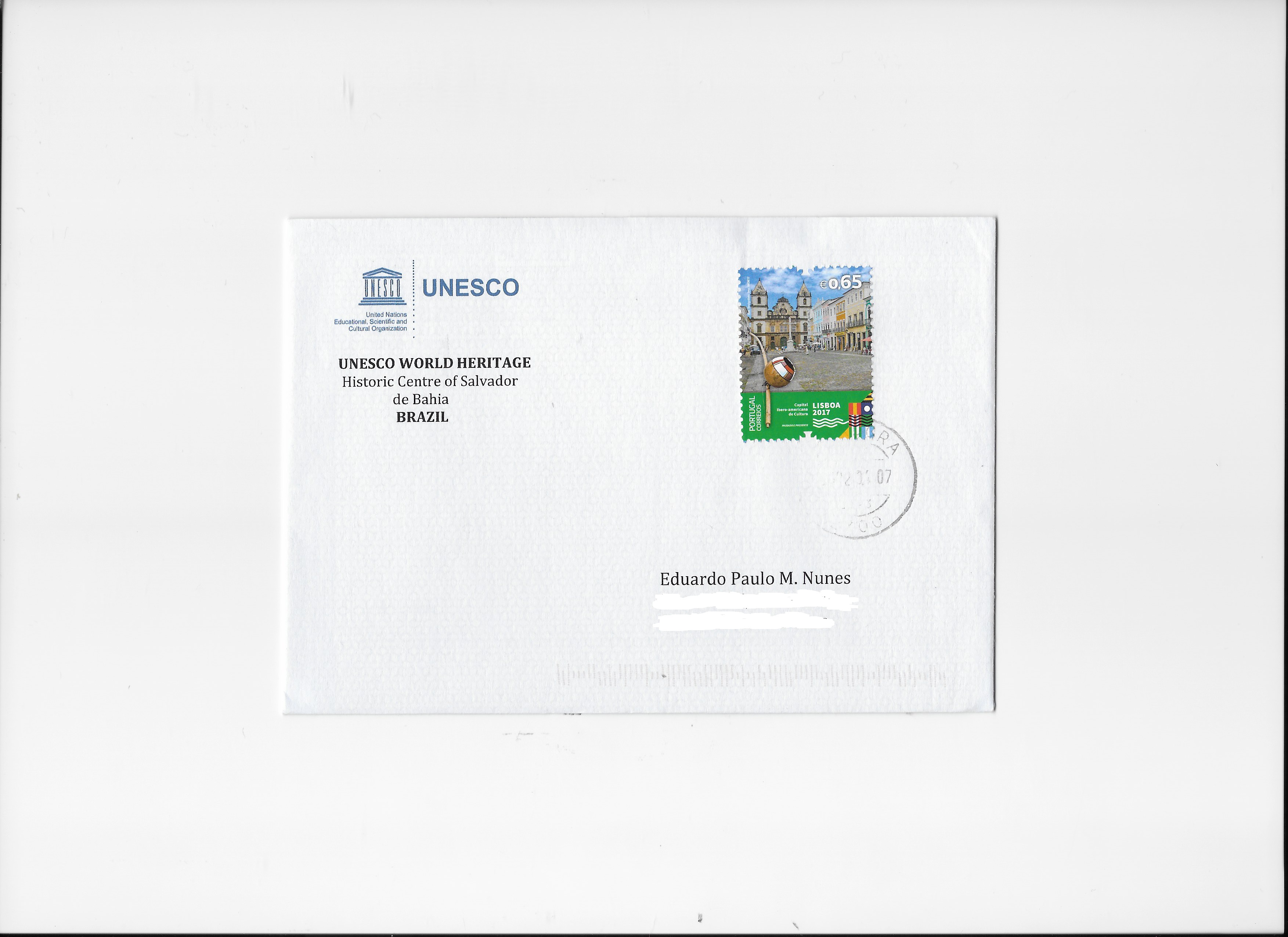
This cover from Portugal depicts one single stamp, showing a picture of the town of Salvador de Bahia, Brazil. The Historic Centre of Salvador de Bahia in Brazil, is a historic neighborhood in western Salvador, Bahia. It was the city's center during the Portuguese colonial period and was named for the whipping post in its central plaza where enslaved people from Africa were publicly beaten as punishment for alleged infractions. The Historic Centre is extremely rich in historical monuments dating from the 17th through the 19th centuries. Salvador was the first colonial capital of Brazil and the city is one of the oldest in the New World (founded in 1549 by Portuguese settlers). It was also one of the first slave markets on the continent, with slaves arriving to work on the sugar plantations. The area is in the older part of the upper city (Cidade Alta) of Salvador. It encompasses several blocks around the triangular Largo, and it is the location for music, dining and nightlife. It has a place on the national historic register and was named a world cultural center by UNESCO in 1985.
Saturday, 11 June 2022
NAURU
This exotic cover came from Nauru, a new country in my collection. Nauru, officially the Republic of Nauru and formerly known as Pleasant Island, is an island country and microstate in Oceania, in the Central Pacific. Its nearest neighbour is Banaba Island in Kiribati, 300 km to the east. It further lies northwest of Tuvalu, 1,300 km northeast of Solomon Islands, east-northeast of Papua New Guinea, southeast of the Federated States of Micronesia and south of the Marshall Islands. With only a 21 km2 area, Nauru is the third-smallest country in the world behind Vatican City and Monaco, making it the smallest republic as well as the smallest island nation. Its population of about 10,000 is the world's second-smallest (not including colonies or overseas territories), after Vatican City. Settled by people from Micronesia circa 1000 BCE, Nauru was annexed and claimed as a colony by the German Empire in the late 19th century. After World War I, Nauru became a League of Nations mandate administered by Australia, New Zealand, and the United Kingdom. During World War II, Nauru was occupied by Japanese troops, and was bypassed by the Allied advance across the Pacific. After the war ended, the country entered into United Nations trusteeship. Nauru gained its independence in 1968, and became a member of the Pacific Community (SPC) in 1969.
RUSSIAN FEDERATION
This cover from Russia depicts a complete set issued in 2019 with Pre-historic archaelogical artifacts. The 40p stamp at the inferior right corner represents the Petroglyphs of Lake Onega and The White Sea a UNESCO World Heritage Site in Russia, Republic of Karelia, listed in 2021. The World Heritage Site comprises 33 petroglyph sites in two clusters. The Lake Onega cluster, Pudozhsky District, has 22 petroglyph sites with over 1200 figures. They mostly depict birds, animals, half-human and half-animal figures, as well as geometric shapes possibly representing the moon and the sun. The cluster at the White Sea (Belomorsky District) has 11 sites with over 3400 figures, mostly representing hunting and sailing scenes, together with related equipment, as well as animal and human footprints. They were created 6 and 7 millennia ago and represent a glimpse into the lives of Neolithic cultures of Fennoscandia.
UN NEW YORK
This cover from United Nations (New York Office) depicts 2 stamps of same ype, celebrating the Mausoleum of the First Qin Emperor. The Mausoleum of the First Qin Emperor (Qin Shi Huang) is located in Lintong District, Xi'an, Shaanxi province of China. This mausoleum was constructed over 38 years, from 246 to 208 BC, and is situated underneath a 76-meter-tall tomb mound shaped like a truncated pyramid. The layout of the mausoleum is modeled on the Qin capital Xianyang, divided into inner and outer cities. The tomb itself has not yet been excavated. Archaeological explorations currently concentrate on various sites of the extensive necropolis surrounding the tomb, including the Terracotta Army to the east of the tomb mound. The Terracotta Army served as a garrison to the mausoleum and has yet to be completely excavated. In 1987, the mausoleum, including the Terracotta Warriors, was listed as World Heritage Sites.
Subscribe to:
Posts (Atom)