Tuesday, 21 June 2022
Sunday, 19 June 2022
VIETNAM
This cover from Vietnam depicts a miniature sheet issued in 2015, celebrating the Trang An Landscape Complex. Tràng An is a scenic area located at the southern margin of the Red River Delta. It contains limestone karst peaks with valleys. There are archaeological traces of human activity for more than 30,000 years, dating back from the Neolithic and Bronze Ages. Hoa Lư was the ancient capital of Vietnam, established in the 10th and 11th centuries. On 23 June 2014, at the 38th session of the World Heritage Committee in Doha, the Trang An Scenic Landscape Complex was inscribed as a UNESCO World Heritage Site.
GERMANY
This special cover from Germany celebrates the 20th anniversary of the inscription of Stralsund and Wismar as a Wordl Heritage Site. The Historic Centers of Stralsund and Wismar are inscribed as UNESCO world hertitage sites since 2002. The two towns were major Hanseatic League trading centres in the 14th and 15th centuries. They then served as defensive and administrative centres for Sweden two hundred years later, notably during the Thirty Years' War. The architectural styles from both of these periods remain and are well-preserved.
PORTUGAL
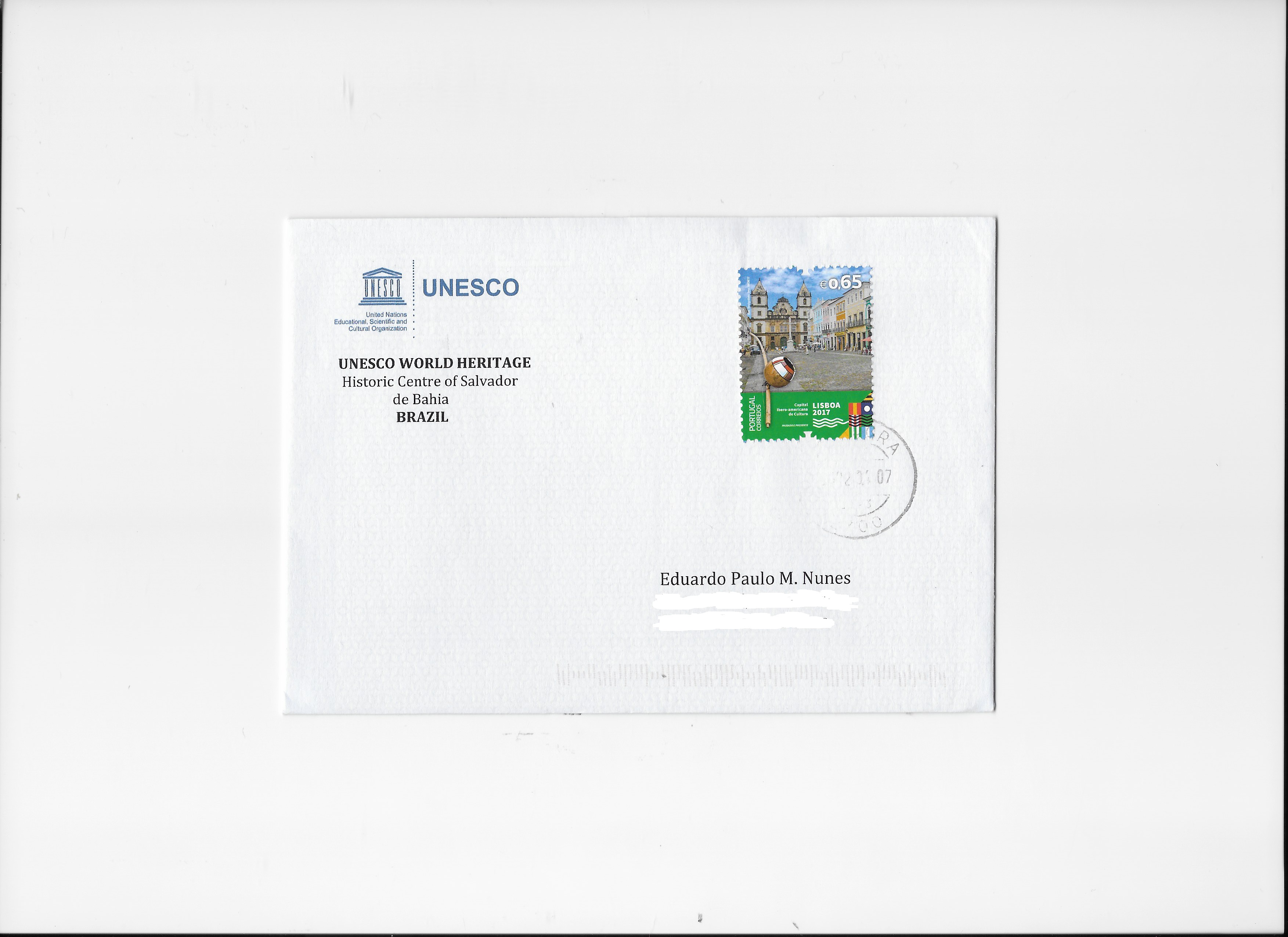
This cover from Portugal depicts one single stamp, showing a picture of the town of Salvador de Bahia, Brazil. The Historic Centre of Salvador de Bahia in Brazil, is a historic neighborhood in western Salvador, Bahia. It was the city's center during the Portuguese colonial period and was named for the whipping post in its central plaza where enslaved people from Africa were publicly beaten as punishment for alleged infractions. The Historic Centre is extremely rich in historical monuments dating from the 17th through the 19th centuries. Salvador was the first colonial capital of Brazil and the city is one of the oldest in the New World (founded in 1549 by Portuguese settlers). It was also one of the first slave markets on the continent, with slaves arriving to work on the sugar plantations. The area is in the older part of the upper city (Cidade Alta) of Salvador. It encompasses several blocks around the triangular Largo, and it is the location for music, dining and nightlife. It has a place on the national historic register and was named a world cultural center by UNESCO in 1985.
Saturday, 11 June 2022
NAURU
This exotic cover came from Nauru, a new country in my collection. Nauru, officially the Republic of Nauru and formerly known as Pleasant Island, is an island country and microstate in Oceania, in the Central Pacific. Its nearest neighbour is Banaba Island in Kiribati, 300 km to the east. It further lies northwest of Tuvalu, 1,300 km northeast of Solomon Islands, east-northeast of Papua New Guinea, southeast of the Federated States of Micronesia and south of the Marshall Islands. With only a 21 km2 area, Nauru is the third-smallest country in the world behind Vatican City and Monaco, making it the smallest republic as well as the smallest island nation. Its population of about 10,000 is the world's second-smallest (not including colonies or overseas territories), after Vatican City. Settled by people from Micronesia circa 1000 BCE, Nauru was annexed and claimed as a colony by the German Empire in the late 19th century. After World War I, Nauru became a League of Nations mandate administered by Australia, New Zealand, and the United Kingdom. During World War II, Nauru was occupied by Japanese troops, and was bypassed by the Allied advance across the Pacific. After the war ended, the country entered into United Nations trusteeship. Nauru gained its independence in 1968, and became a member of the Pacific Community (SPC) in 1969.
RUSSIAN FEDERATION
This cover from Russia depicts a complete set issued in 2019 with Pre-historic archaelogical artifacts. The 40p stamp at the inferior right corner represents the Petroglyphs of Lake Onega and The White Sea a UNESCO World Heritage Site in Russia, Republic of Karelia, listed in 2021. The World Heritage Site comprises 33 petroglyph sites in two clusters. The Lake Onega cluster, Pudozhsky District, has 22 petroglyph sites with over 1200 figures. They mostly depict birds, animals, half-human and half-animal figures, as well as geometric shapes possibly representing the moon and the sun. The cluster at the White Sea (Belomorsky District) has 11 sites with over 3400 figures, mostly representing hunting and sailing scenes, together with related equipment, as well as animal and human footprints. They were created 6 and 7 millennia ago and represent a glimpse into the lives of Neolithic cultures of Fennoscandia.
UN NEW YORK
This cover from United Nations (New York Office) depicts 2 stamps of same ype, celebrating the Mausoleum of the First Qin Emperor. The Mausoleum of the First Qin Emperor (Qin Shi Huang) is located in Lintong District, Xi'an, Shaanxi province of China. This mausoleum was constructed over 38 years, from 246 to 208 BC, and is situated underneath a 76-meter-tall tomb mound shaped like a truncated pyramid. The layout of the mausoleum is modeled on the Qin capital Xianyang, divided into inner and outer cities. The tomb itself has not yet been excavated. Archaeological explorations currently concentrate on various sites of the extensive necropolis surrounding the tomb, including the Terracotta Army to the east of the tomb mound. The Terracotta Army served as a garrison to the mausoleum and has yet to be completely excavated. In 1987, the mausoleum, including the Terracotta Warriors, was listed as World Heritage Sites.
Wednesday, 8 June 2022
INDIA
This cover from India depicts 2 different stamps. The stamp on the top celebrates the World Heritage Site Khajuraho Group of Monuments. The Khajuraho Group of Monuments are a group of Hindu and Jain temples in Chhatarpur district, Madhya Pradesh, India, about 175 kilometres southeast of Jhansi. They are a UNESCO World Heritage Site since 1986. The temples are famous for their nagara-style architectural symbolism and a few erotic sculptures. Most Khajuraho temples were built between 885 AD and 1050 AD by the Chandela dynasty. Historical records note that the Khajuraho temple site had 85 temples by the 12th century, spread over 20 square kilometers. Of these, only about 25 temples have survived, spread over six square kilometers. Of the surviving temples, the Kandariya Mahadeva Temple is decorated with a profusion of sculptures with intricate details, symbolism and expressiveness of ancient Indian art.
Friday, 3 June 2022
BANGLADESH
This beautiful UNESCO cover came from Bangladesh and depicts a miniature sheet celebrating the Sundarbans. Sundarbans is a mangrove area in the delta formed by the confluence of the Padma, Brahmaputra and Meghna Rivers in the Bay of Bengal. It spans the area from the Baleswar River in Bangladesh's division of Khulna to the Hooghly River in India's state of West Bengal. It comprises closed and open mangrove forests, land used for agricultural purpose, mudflats and barren land, and is intersected by multiple tidal streams and channels. Four protected areas in the Sundarbans are enlisted as UNESCO World Heritage Sites since 1997: Sundarbans West (Bangladesh), Sundarbans South (Bangladesh), Sundarbans East (Bangladesh) and Sundarbans National Park (India).
ROMANIA
This cover from Romania depicts a complete set issued in 2014 celebrating the region of Maramures. The 8,10 leu stamp shows a picture of the Church of the Holy Archangels in Șurdești , which is a part of the UNESCO site Wooden Churches of Maramures This site comprises eight churches from the 17th and 18th century in Maramureș County. The churches are made of wood and they combine influences of Orthodox and Gothic architecture styles. Some of the common characteristics of the churches include tall, slim clock towers and roofs covered by shingles. The list includes the Church of the Presentation of the Virgin in the Temple in Bârsana, the Church of Saint Nicholas in Budești, the Saint Parascheva Church in Desești, the Church of the Nativity of the Virgin in Ieud Deal, the Church of the Holy Archangels in Plopiș, the Saint Parascheva Church in Poienile Izei, the Church of the Holy Archangels in Rogoz and the Church of the Holy Archangels in Șurdești. These eight churches were listed by the UNESCO as World Heritage Sites in 1999, for their religious architecture and timber construction traditions.
UNITED STATES OF AMERICA
This cover from USA depicts 8 first class stamps (4 of each type) celebrating the Statue of Liberty. The Statue of Liberty is a colossal neoclassical sculpture on Liberty Island in New York Harbor in New York City, in the United States. The copper statue, a gift from the people of France to the people of the United States, was designed by French sculptor Frédéric Auguste Bartholdi and its metal framework was built by Gustave Eiffel. The statue was dedicated on October 28, 1886. The statue is a figure of Libertas, a robed Roman liberty goddess. She holds a torch above her head with her right hand, and in her left hand carries a tabula ansata inscribed JULY IV MDCCLXXVI (July 4, 1776 in Roman numerals), the date of the U.S. Declaration of Independence. A broken shackle and chain lie at her feet as she walks forward, commemorating the recent national abolition of slavery. After its dedication, the statue became an icon of freedom and of the United States, seen as a symbol of welcome to immigrants arriving by sea. It became a UNESCO World Heritage Site in 1984.
Etiquetas:
Unesco World Heritage,
USA,
USA - Statue of Liberty
Subscribe to:
Posts (Atom)