Wednesday, 13 April 2022
FRANCE
This cover came from France and depicts 2 stamps. The stamp on the left is part of a set issued in 2016 celebrating the Netherlands capital, Amsterdam. It shows a picture of Le béguinage. A beguinage (from the French béguinage) is an architectural complex which was housing beguines. They were mainly built in Flanders and the Netherlands, but there are few in North-East France and North-West Germany. A beguinage usually included an inner court, houses facing this garden and a church, or a chapel. There were often walls surrounding the entire complex, separating it from the rest of the town and one or two gates to get in. Some would also include a convent or an infirmary. Beguinages were built around the XIII century and generally abandoned in the XIX-XX century. They are nowadays almost always UNESCO sites (inscribed in 1998). Their maintenance and look is protected and conserved as pieces of art. And their houses are often considered trendy areas where artists live. Amsterdam beguinage is an architectural jewel. It was originally surrounded not only by walls, but by the canals too. The entrance used to be a bridge, but nowadays there’s a more handy gate to give access to the inner garden and the church. This beguinage has an interesting history. In 1578, when Amsterdam turned Calvinist, practicing any other religion was forbidden. But since its houses were actually private properties, the beguinage had a special status of freedom. Its real churchwas officially closed down, but in 1671 two of the houses were reshaped into a chapel. It perfectly worked as a well hidden underground church thanks to the fact that all those buildings had no windows towards the city but only to the inner courtyard. .
UNITED NATIONS (VIENNA OFFICE)
A nice UNESCO cover from United Nations (Vienna Office), depicting a complete set issued in 2005 with 6 World Heritage Sites in Egypt: Ancient Thebes with its Necropolis, Nubian Monuments from Abu Simbel to Philae, Memphis and its Necropolis – the Pyramid Fields from Giza to Dahshur, Historic Cairo, Saint Catherine Area and Abu Mena.
GERMANY
This beautiful cover came from Germany and depicts a stamp issued in 2017 celebrating the Wartburg Castle. The Wartburg is a castle originally built in the Middle Ages. It is situated on a precipice of 410 meters to the southwest of and overlooking the town of Eisenach, in the state of Thuringia, Germany. In 1999, UNESCO added Wartburg Castle to the World Heritage List. It was the home of St. Elisabeth of Hungary, the place where Martin Luther translated the New Testament of the Bible into German, the site of the Wartburg festival of 1817 and the supposed setting for the possibly legendary Sängerkrieg. It was an important inspiration for Ludwig II when he decided to build Neuschwanstein Castle. Wartburg is the most-visited tourist attraction in Thuringia after Weimar. Although the castle today still contains substantial original structures from the 12th through 15th centuries, much of the interior dates back only to the 19th century.
Etiquetas:
Europa Cept,
Germany,
Germany - Wartburg Castle,
Unesco World Heritage
Monday, 11 April 2022
UN NEW YORK
Another cover from United Nations (New York Office), depicting 4 stamps (2 of each type) celebrating 2 Heritage Sites in Cuba: the Historic Centre of Camagüey and the Historic Centre of Cienfuegos. Camagüey was founded as Santa María del Puerto del Príncipe in 1514, by Spanish colonists on the northern coast and moved inland in 1528, to the site of a Taino village named Camagüey. It was one of the seven original settlements (villas) founded in Cuba by the Spanish. After Henry Morgan burned the city in the 17th century, it was redesigned like a maze so attackers would find it hard to move around inside the city. In July 2008, the old town was designated a UNESCO World Heritage Site, because of its irregular, maze-like city planning, its prominent role in early Spanish colonization and agriculture, and its rich architecture showing a variety of influences.
The Historic Centre of Cienfuegos, is located in the city of Cienfuegos. It was declared a UNESCO World Heritage Site in 2005, because of its outstanding Neoclassical architecture architecture and its status as the best example of early 19th century Spanish urban planning. The historic centre contains six buildings from 1819–50, 327 buildings from 1851–1900, and 1188 buildings from the 20th century.
UN NEW YORK
A nice cover from United Nations (New York Office), depicting 4 stamps (2 of each type) celebrating 2 Heritage Sites in Cuba: Old Havana and its Fortifications and the Viñales Valley. Old Havana (Spanish: La Habana Vieja) is the city-center (downtown) and one of the 15 municipalities (or boroughs) forming Havana, Cuba. The positions of the original Havana city walls are the modern boundaries of Old Havana. In 1982, Old Havana was inscribed in the UNESCO World Heritage List, because of its unique Baroque and neoclassical architecture, its fortifications, and its historical importance as a stop on the route to the New World. Viñales Valley (Spanish: Valle de Viñales) is a karstic depression in Cuba. The valley has an area of 132 km2 and is located in the Sierra de los Órganos mountains (part of Guaniguanico range), just north of Viñales in the Pinar del Río Province. In 1999, the valley was inscribed on the UNESCO World Heritage List as a cultural landscape because of its use of traditional tobacco-growing techniques.[
UN NEW YORK
A beautiful cover from United Nations (New York Office), depicting 4 stamps (2 of each type) celebrating 2 Heritage Sites in Cuba: Trinidad and the Valley de los Ingenios (since 1988) and the San Pedro de la Roca Castle in Santiago de Cuba. The city of Trinidad was founded in the early 16th century. In 1518, Hernán Cortés began his expedition to conquer Mexico from the port at Trinidad. The city prospered throughout the colonial period in large part due to the success of the local sugar industry. The adjacent Valley de los Ingenios was the origin of the Cuban sugar industry, which emerged in the 18th century. It is home to numerous cane sugar mills, as well as cattle ranches and tobacco plantations. The Castillo de San Pedro de la Roca (also known by the less formal title of Castillo del Morro or as San Pedro de la Roca Castle) is a fortress on the coast of the Cuban city of Santiago de Cuba. About 10 km)southwest of the city centre, it overlooks the bay. The fortress was declared a World Heritage Site by UNESCO in 1997, cited as the best preserved and most complete example of Spanish-American military architecture.
Tuesday, 5 April 2022
NETHERLANDS
This beatiful cover came from Netherlands and depicts a miniature sheet celebrating the UNESCO World Heritage Site Semmering Railway. The Semmering railway (German: Semmeringbahn) in Austria, which starts at Gloggnitz and leads over the Semmering to Mürzzuschlag, was the first mountain railway in Europe built with a standard gauge track. It is commonly referred to as the world's first true mountain railway, given the very difficult terrain and the considerable altitude difference that was mastered during its construction. It is still fully functional as a part of the Southern Railway which is operated by the Austrian Federal Railways. The Semmering railway was constructed between 1848 and 1854 by some 20,000 workers under the project's designer and director Carl von Ghega born in Venice as Carlo Ghega in an Albanian family. The construction features 14 tunnels (among them the 1,431 m summit tunnel), 16 viaducts (several two-storey) and over 100 stone arch bridges and 11 small iron bridges. The stations and the buildings for the supervisors were often built directly from the waste rock dug out when making the tunnels. In 1998 the Semmering railway was added to the list of the UNESCO World Heritage sites.
Etiquetas:
Austria - Semmering Railway,
Netherlands,
Unesco World Heritage
UN NEW YORK
A beautiful cover from United Nations (New York Office), depicting 4 stamps (2 of each type) celebrating 2 Heritage Sites in Japan: the Historic Monuments of Ancient Nara and the Itsukushima Shinto Shrine. The UNESCO World Heritage Site Historic Monuments of Ancient Nara encompasses eight places in the old capital Nara in Nara Prefecture, Japan. Five are Buddhist temples, one is a Shinto shrine, one is a Palace and one a primeval forest. UNESCO listed the site as World Heritage in 1998. Itsukushima Shrine is a Shinto shrine on the island of Itsukushima (popularly known as Miyajima), best known for its "floating" torii gate. It is in the city of Hatsukaichi in Hiroshima Prefecture in Japan. The shrine complex is listed as a UNESCO World Heritage Site since 1996, and the Japanese government has designated several buildings and possessions as National Treasures.
Saturday, 2 April 2022
UN NEW YORK
A beautiful cover from United Nations (New York Office), depicting 4 stamps (2 of each type) celebrating 2 Heritage Sites in Japan: the Himeji Castle and the Shrines and Temples of Nikko. Himeji Castle (Himeji-jō) is a hilltop Japanese castle complex situated in the city of Himeji which is located in the Hyōgo Prefecture of Japan. The castle is regarded as the finest surviving example of prototypical Japanese castle architecture, comprising a network of 83 rooms with advanced defensive systems from the feudal period. Himeji Castle is the largest and most visited castle in Japan, and it was registered in 1993 as one of the first UNESCO World Heritage Sites in the country. The UNESCO World Heritage Site Shrines and Temples of Nikkō encompasses 103 buildings or structures and the natural setting around them. It is located in Nikkō, Tochigi Prefecture, Japan. The buildings belong to two Shinto shrines (Futarasan Shrine and Tōshō-gū) and one Buddhist temple (Rinnō-ji). Nine of the structures are designated National Treasures of Japan while the remaining 94 are Important Cultural Properties. UNESCO listed the site as World Heritage in 1999.
Friday, 1 April 2022
UN NEW YORK
A beautiful cover from United Nations (New York Office), depicting 4 stamps (2 of each type) celebrating 2 Heritage Sites in Japan: the Historic Monuments of Kyoto and the Historic Villages of Shirakawa-go and Gokayama. The UNESCO World Heritage Site Historic Monuments of Ancient Kyoto encompasses 17 locations in Japan within the city of Kyoto and its immediate vicinity. In 794, the Japanese imperial family moved the capital to Heian-kyō. Heian-kyō is located in today’s Kyoto city, a city that imitates Luoyang, China.The locations are in three cities: Kyoto and Uji in Kyoto Prefecture; and Ōtsu in Shiga Prefecture; Uji and Ōtsu border Kyoto to the south and north, respectively. Of the monuments, 13 are Buddhist temples, three are Shinto shrines, and one is a castle. The properties include 38 buildings designated by the Japanese government as National Treasures, 160 properties designated as Important Cultural Properties, eight gardens designated as Special Places of Scenic Beauty, and four designated as Places of Scenic Beauty. UNESCO listed the site as World Heritage in 1994. The Historic Villages of Shirakawa-gō and Gokayama are another of Japan's UNESCO World Heritage Sites. The cultural property consists of three historic mountain villages over an area of 68 hectares in the remote Shogawa river valley, stretching across the border of Gifu and Toyama Prefectures in central Japan. Shirakawa-gō is located in the village of Shirakawa in Gifu Prefecture. The Gokayama area is divided between the former villages of Kamitaira and Taira in Nanto, Toyama Prefecture.
SPAIN
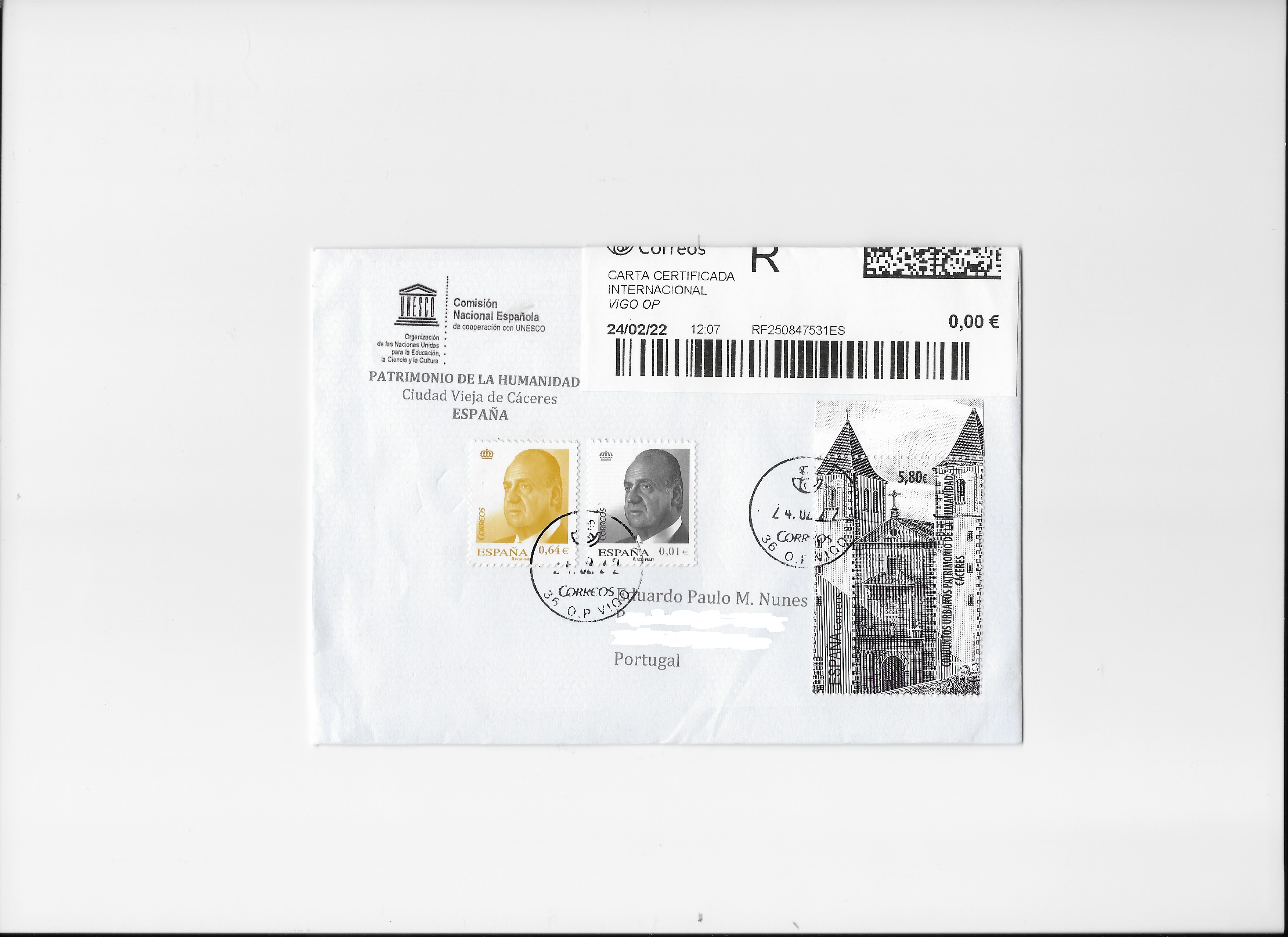
This cover came from Spain and depicts a 5,80€ stamp celebrating the Old Town of Cáceres, an historic walled city in Cáceres, Spain. Cáceres was declared a World Heritage City by UNESCO in 1986 because of the city's blend of Roman, Moorish, Northern Gothic and Italian Renaissance architecture. Thirty towers from the Islamic period still stand in Cáceres, of which the Torre del Bujaco is the most famous. There have been settlements near Cáceres since prehistoric times. Evidence of this can be found in the caves of Maltravieso and El Conejar. The city was founded by the Romans in 25 BC. The Old Town (Parte Antigua) still has its ancient walls; this part of town is also well known for its multitude of storks' nests. The walls contain a medieval town setting with no outward signs of modernity, which is why many television shows and films have been shot there.
Etiquetas:
Spain,
Spain - Old Town of Cáceres,
Unesco World Heritage
UNITED STATES OF AMERICA
This cover from USA depicts 3 stamps, including the stamp on the right corner, celebrating the Yellowstone National Park, an American national park located in the western United States, largely in the northwest corner of Wyoming and extending into Montana and Idaho. It was established by the U.S. Congress and signed into law by President Ulysses S. Grant on March 1, 1872. Yellowstone was the first national park in the U.S. and is also widely held to be the first national park in the world. The park is known for its wildlife and its many geothermal features, especially the Old Faithful geyser, one of its most popular. While it represents many types of biomes, the subalpine forest is the most abundant. It is part of the South Central Rockies forests ecoregion. Yellowstone National Park is inscribed as a World Heritage Site by UNESCO since 1978.
Etiquetas:
Unesco World Heritage,
USA,
USA - Yellowstone National Park
Subscribe to:
Posts (Atom)