Thursday, 3 February 2022
Tuesday, 1 February 2022
PORTUGAL
This cover from Portugal depicts 3 stamps (from a set of 6) issued in 2012, on motive Palaces and Castles of Portugal. The 3 palaces depicted are: Portuguese Renaissance Sintra Palace, Monserrate Palace and the medieval Castle of the Moors, all of them part of the UNESCO World Heritage Site Cultural Landscape of Sintra. Sintra is a town and municipality in the Greater Lisbon region of Portugal, located on the Portuguese Riviera. The municipality of Sintra has several historic palaces, castles, scenic beaches, parks and gardens. The area includes the Sintra-Cascais Nature Park through which the Sintra Mountains run. The historic center of the Vila de Sintra is famous for its 19th-century Romanticist architecture, historic estates and villas, gardens, and royal palaces and castles, which resulted in the classification of the town as a UNESCO World Heritage Site (since 1995). Sintra's landmarks include the medieval Castle of the Moors, the romanticist Pena National Palace and the Portuguese Renaissance Sintra National Palace.
Saturday, 29 January 2022
UKRAINE
This beautiful cover from Ukraine (issued in 2019), celebrates Kyiv, the capital and most populous city in Ukraine. One of the stamps features the Saint-Sophia Cathedral. The monument is part of the Unesco World Heritage Site Kyiv: Saint-Sophia Cathedral and Related Monastic Buildings, Kyiv-Pechersk Lavra. This is a monastic ensemble which was developing from the 11th to the 19th centuries. It comprises churches, monasteries, and caves where saints were buried. It was an important centre of Eastern Orthodox Church. The site was recognized by the UNESCO World Heritage Program in 1990 as one complex. The Church of the Saviour at Berestove, adjacent to the Lavra, was added to the site in 2005.
SWITZERLAND
This cover from Switzerland depict a joint set with Japan issued in 2014. The 100 stamp (on the left) celebrates the Mount Fuji. Mount Fuji, located on the island of Honshū (the "mainland"), is the highest mountain in Japan, standing 3,776.24 m. It is the second-highest volcano located on an island in Asia (after Mount Kerinci on the island of Sumatra), and seventh-highest peak of an island on Earth. It was added to the World Heritage List as a Cultural Site on June 22, 2013. According to UNESCO, Mount Fuji has "inspired artists and poets and been the object of pilgrimage for centuries". UNESCO recognizes 25 sites of cultural interest within the Mount Fuji locality. These 25 locations include the mountain and the Shinto shrine, Fujisan Hongū Sengen Taisha, as well as the Buddhist Taisekiji Head Temple founded in 1290, later depicted by Japanese ukiyo-e artist Katsushika Hokusai.
INDIA
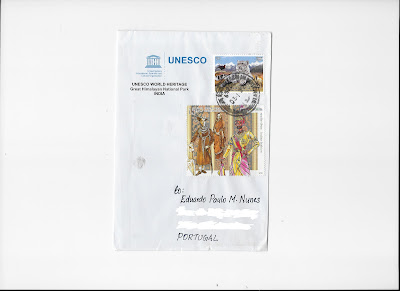
This cover from India depict a 5,00 FAUNA stamp celebrating the Great Himalayan National Park. The Great Himalayan National Park is a national park in India, located in Kullu region in the state of Himachal Pradesh. The park was established in 1984 and is spread over an area of 1171 km2; altitudes within the park range between 1500 and 6000 m. The Great Himalayan National Park is a habitat to numerous flora and more than 375 fauna species, including approximately 31 mammals, 181 birds, 3 reptiles, 9 amphibians, 11 annelids, 17 mollusks and 127 insects. They are protected under the strict guidelines of the Wildlife Protection Act of 1972; hence any sort of hunting is not permitted. In June 2014, the Great Himalayan National Park was added to the UNESCO list of World Heritage Sites, under the criterion of "outstanding significance for biodiversity conservation".
Wednesday, 26 January 2022
SPAIN
This cover from Spain depict a 0,24€ issued in 2004 celebrating the Archaeological Site of Atapuerca. The Atapuerca Mountains (Spanish: Sierra de Atapuerca) is a karstic hill formation near the village of Atapuerca in the province of Burgos (autonomous community of Castile and Leon), northern Spain. In a still ongoing excavation campaign, rich fossil deposits and stone tool assemblages have been discovered which are attributed to the earliest known hominin residents in Western Europe. This "exceptional reserve of data" has been deposited during extensive Lower Paleolithic presence, as the Atapuerca Mountains served as the preferred occupation site of Homo erectus, Homo antecessor, Homo heidelbergensis and Homo neanderthalensis communities. The earliest specimen so far unearthed and reliably dated confirm an age between 1.2 million and 630,000 years. The Archaeological site of Atapuerca is a World Heritage Site since 2000. Some finds are exhibited in the nearby Museum of Human Evolution, in Burgos.
Sunday, 23 January 2022
MOROCCO
This cover from Morocco depict a single stamp celebrating the Al Aqsa Mosque, in Jerusalem (Al Qods in arabic). The Old City of Jerusalem and its walls is also listed by UNESCO as a World Heritage Site since 1981. It was proposed as a site by Jordan. The site is not assigned to a state on the UNESCO listing. In 2011 UNESCO stated "The Old City of Jerusalem" is inscribed on the World Heritage List and the List of World Heritage in Danger.
Friday, 21 January 2022
PORTUGAL
This UNESCO cover from Portugal depict a miniature sheet issued in 2012 celebrating the Levadas of Madeira. In a region where the forest is a World Heritage Site, walking along the levadas of Madeira is a unique way to discover exuberant nature, where the most extensive Laurissilva forest of the Atlantic islands persists, a testament to the ancestral nature of the region. They extend for more than 3 thousand kilometers and wind through steep paths, mountain peaks, natural tunnels that cross the rock, crystalline lagoons and exuberant vegetation, always to the sound of running water. We are talking about the Levadas of Madeira, a set of routes that invite you to unique moments of communion with nature. Walking along one of Madeira's levadas is to discover the Laurissilva , an endemic forest of Macaronesia - a region formed by the archipelagos of Madeira, Azores, Canary Islands and Cape Verde -, on routes that take visitors to the highest points of the island and to the encounter of countless rare species, some unique to Madeira, others from the most remote places in the world.
The Laurissilva of Madeira became a UNESCO Natural World Heritage Site in December 1999.
Subscribe to:
Posts (Atom)