Monday, 8 November 2021
SPAIN
A nice UNESCO cover from Spain, featuring a stamp celebrating the University and Historic Centre of Alcalá de Henares. Alcalá de Henares is a Spanish city in the Community of Madrid. Straddling the Henares River, it is located 35 kilometres to the northeast of the centre of Madrid. Predated by earlier settlements on the left bank of the Henares, the city has its origins in the Complutum settlement founded in Roman times on the right bank (north) of the river, that became a bishopric seat in the 5th century. One of the several Muslim citadels in the Middle Mark of al-Andalus (hence the name Alcalá, a derivative of the Arabic term for citadel) was established on the left bank, while, after the Christian conquest culminated circa 1118, the bulk of the urban nucleus returned to the right bank. For much of the late middle-ages and the early modern period before becoming part of the province of Madrid, Alcalá de Henares was a seigneurial estate of the archbishops of Toledo. Its historical centre is one of UNESCO's World Heritage Sites since 1998. The city has a long university tradition. Francisco Jiménez de Cisneros founded the Complutense University in Alcalá de Henares in the late 15th century. The city currently hosts the (refounded) University of Alcalá. It is the native city of Miguel de Cervantes.
Friday, 5 November 2021
PORTUGAL
This UNESCO cover from Portugal depicts a miniature sheet issued in 2015 with a picture of the Cathedral of Santiago de Compostela, in Spain. The city of Santiago de Compostela has its origin in the shrine of Saint James the Great, now the Cathedral of Santiago de Compostela, as the destination of the Way of St. James, a leading Catholic pilgrimage route since the 9th century. The town was destroyed by Muslims in the 10th century and rebuilt during the following century. In 1985, the city's Old Town was designated a UNESCO World Heritage Site.
SLOVAKIA
This UNESCO cover from Slovakia depicts a set of 2 stamps issued in 2009, celebrating the Danube Roman Limes. The Danubian Limes, a network of fortifications along the Danube river, protected the borders of the Roman Empire. The site is shared with Germany and Austria. Six sites at two locations, of military camps Celemantia and Gerulata, are listed in Slovakia. In 2021, the western segment of the Danube Limes were inscribed on the UNESCO World Heritage List as part of the set of "Frontiers of the Roman Empire" World Heritage Sites.
BOSNIA & HERZEGOVINA
Etiquetas:
Bosnia and Herzegovina,
Europa Cept,
Fauna - Birds
Wednesday, 3 November 2021
RUSSIA
This cover from Russia depicts a miniature sheet issued in 2012 with a view from Wrangel Island, a Natural reserve inscribed as a UNESCO World Heritage site since 2004.Located well above the Arctic Circle, the site includes the mountainous Wrangel Island (7,608 km2), Herald Island (11 km2) and surrounding waters. Wrangel was not glaciated during the Quaternary Ice Age, resulting in exceptionally high levels of biodiversity for this region. The island boasts the world’s largest population of Pacific walrus and the highest density of ancestral polar bear dens. It is a major feeding ground for the grey whale migrating from Mexico and the northernmost nesting ground for 100 migratory bird species, many endangered. Currently, 417 species and subspecies of vascular plants have been identified on the island, double that of any other Arctic tundra territory of comparable size and more than any other Arctic island. Some species are derivative of widespread continental forms, others are the result of recent hybridization, and 23 are endemic.
BOSNIA & HERZEGOVINA
Tuesday, 2 November 2021
ICELAND
A nice UNESCO cover from Iceland, depicting 2 se-tenant stamps with a view from the Vatnajökull National Park. Vatnajökull National Park is one of three national parks in Iceland. It encompasses all of Vatnajökull glacier and extensive surrounding areas. These include the national parks previously existing at Skaftafell in the southwest and Jökulsárgljúfur in the north. The unique qualities of Vatnajökull National Park are primarily its great variety of landscape features, created by the combined forces of rivers, glacial ice, and volcanic and geothermal activity.On 5 July 2019, Vatnajökull National Park was inscribed as a World Heritage Site.
DENMARK
This UNESCO cover from Denmark depicts a 30kr stamp celebrating The Par Force Hunting Landscape in New Zealand. The Par force hunting landscape in North Zealand is a collection of hunting grounds and forests north of Copenhagen. The landscape was submitted for admission to the UNESCO List of World Heritage Sites on 1 August 2010 and was inscribed on 4 July 2015. The landscape comprises three main areas: Store Dyrehave, Gribskov and Jægersborg Dyrehave/Jægersborg Hegn, and contains the most significant hunting grounds for the medieval nobility in Denmark. The central-star grid design of the landscape, with numbered roads and stone posts, fences, demonstrates the unique planning and design of hunting landscapes in the 17th and 18th centuries.
Monday, 1 November 2021
SLOVAKIA
In this cover from Slovakia the stamp on the right depicts a picture of the National Park Poloniny, a part of the UNESCO World Heritage site Ancient and Primeval Beech Forests of the Carpathians and Other Regions of Europe. This site comprises undisturbed examples of temperate forests that demonstrate the postglacial expansion process of European beech from a few isolated refuge areas in the Alps, Carpathians, Dinarides, Mediterranean, and Pyrenees. The site was originally listed in 2007 as the Primeval Beech Forests of the Carpathians, shared by Slovakia and Ukraine, extended in 2011 to include the Ancient Beech Forests of Germany, and further extended in 2017 and 2021 to include forests in a total of 18 countries. Four reserves in Slovakia are listed, Stužica – Bukovské vrchy, Rožok, Vihorlat, and Havešová. The modification of the boundaries of forests in Slovakia took place in 2021.
RUSSIA
This beautiful cover from Russia depicts a miniature sheet issued in 2006 celebrating the 250th anniversary of the Grand Palace, Tsarskoye Selo, in St. Petersburg.. The Tsarskoye Selo palace and park ensemble (the Tsarskoye Selo State Museum-Preserve) is a superb monument of world-ranking architecture and garden-and-park design dating from the eighteenth to early twentieth centuries. Called The 'Venice of the North', St. Petersburg, with its numerous canals and more than 400 bridges, is the result of a vast urban project begun in 1703 under Peter the Great. Later known as Leningrad (in the former USSR), the city is closely associated with the October Revolution. Its architectural heritage reconciles the very different Baroque and pure neoclassical styles, as can be seen in the Admiralty, the Winter Palace, the Marble Palace and the Hermitage. Historic Centre of Saint Petersburg and Related Groups of Monuments is the name used by UNESCO when it collectively designated the historic core of the Russian city of St. Petersburg, as well as buildings and ensembles located in the immediate vicinity as a World Heritage Site in 1991. The site was recognised for its architectural heritage, fusing Baroque, Neoclassical, and traditional Russian-Byzantine influences.
BOSNIA (REP. SRPSKA)
A nice UNESCO cover from Bosnia (Rep. Srpska), depicting a complete set issued in 2017 celebrating the "Stecci Medieval Tombstone Graveyards". Stećak or Stećci in plural form is the name for monumental medieval tombstones, that lie scattered across Bosnia and Herzegovina, and the border parts of Croatia, Montenegro and Serbia. An estimated 60,000 are found within the borders of modern Bosnia and Herzegovina and the rest of 10,000 are found in what are today Croatia (4,400), Montenegro (3,500), and Serbia (2,100), at more than 3,300 odd sites with over 90% in poor condition. Appearing in the mid 12th century, with the first phase in the 13th century, the custom of cutting and using stećci tombstones reached its peak in the 14th and 15th century, before being discontinued in the very early 16th century during the Ottoman conquest of Bosnia and Herzegovina. They were a common tradition amongst Bosnian, Catholic and Orthodox Church followers alike, and were used by both Slavic and the Vlach populations. Stećc are inscribed on the World Heritage List by UNESCO since 2016, with a selection of some 4,000 individual monoliths, grouped in necropolises at 28 locations, of which 22 in Bosnia and Herzegovina, two in Croatia, three in Montenegro, and three in Serbia. The one of the best preserved collection of these tombstones is Radimlja, west of Stolac in Bosnia and Herzegovina.
HUNGARY
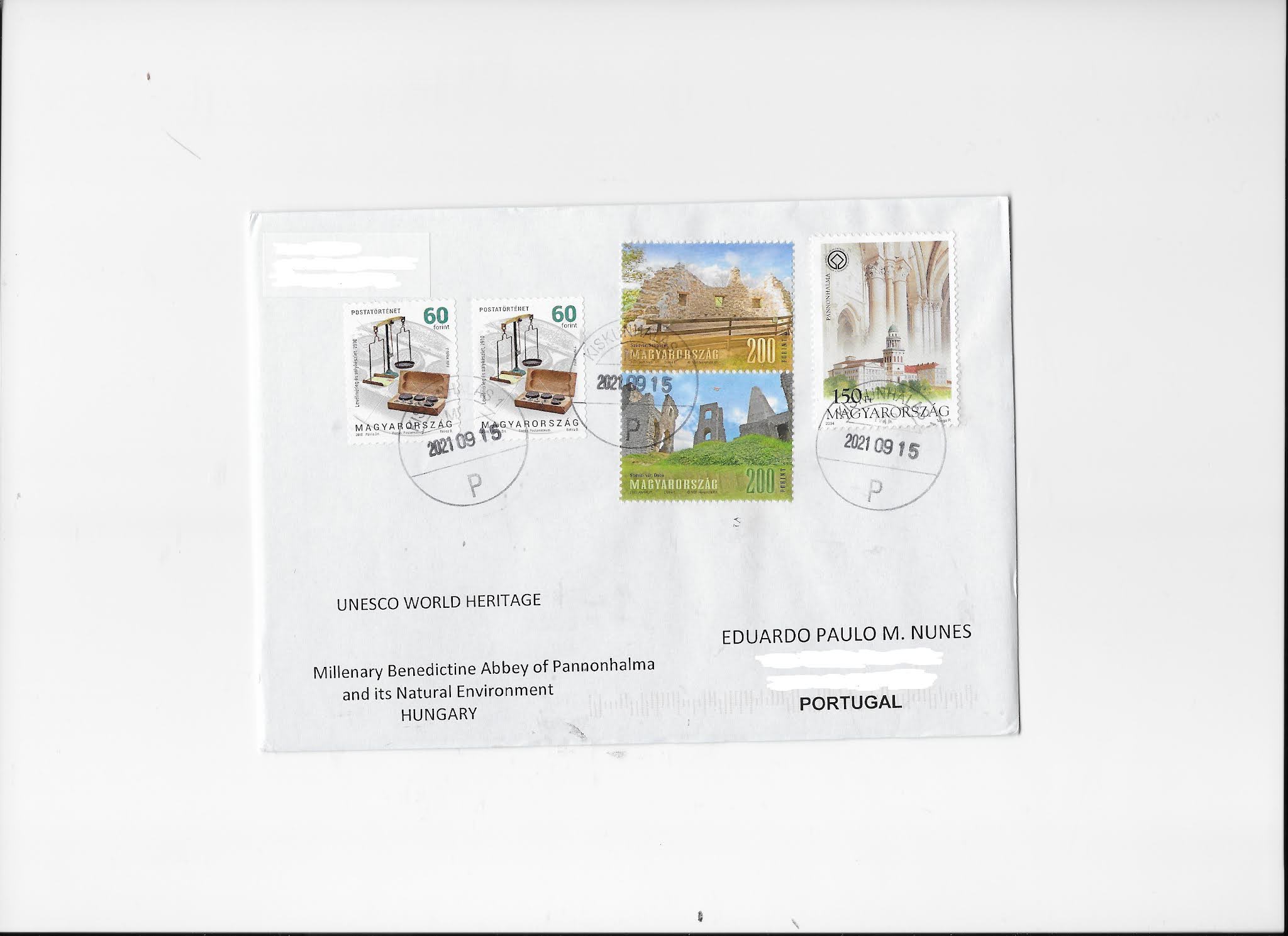
In this cover from Hungary, the 150ft stamp (on the right), celebrates the Millenary Benedictine Abbey of Pannonhalma, inscribed as a UNESCO World Heritage site since 1996. The Archabbey or Territorial Abbey of Pannonhalma (lat. Archiabbatia or Abbatia Territorialis Sancti Martini in Monte Pannoniae) is a medieval building in Pannonhalma, one of the oldest historical monuments in Hungary. Founded in 996, it is located near the town, on top of a hill (282 m). Saint Martin of Tours is believed to have been born at the foot of this hill, hence its former name, Mount of Saint Martin (Hungarian: Márton-hegy), from which the monastery occasionally took the alternative name of Márton-hegyi Apátság. This is the second largest territorial abbey in the world, after the one in Monte Cassino. Its sights include the Basilica with the Crypt (built in the 13th century), the Cloisters, the monumental Library with 360,000 volumes, the Baroque Refectory (with several examples of trompe-l'œil) and the Archabbey Collection (the second biggest in the country).
Subscribe to:
Posts (Atom)